Made and counted by Wren —

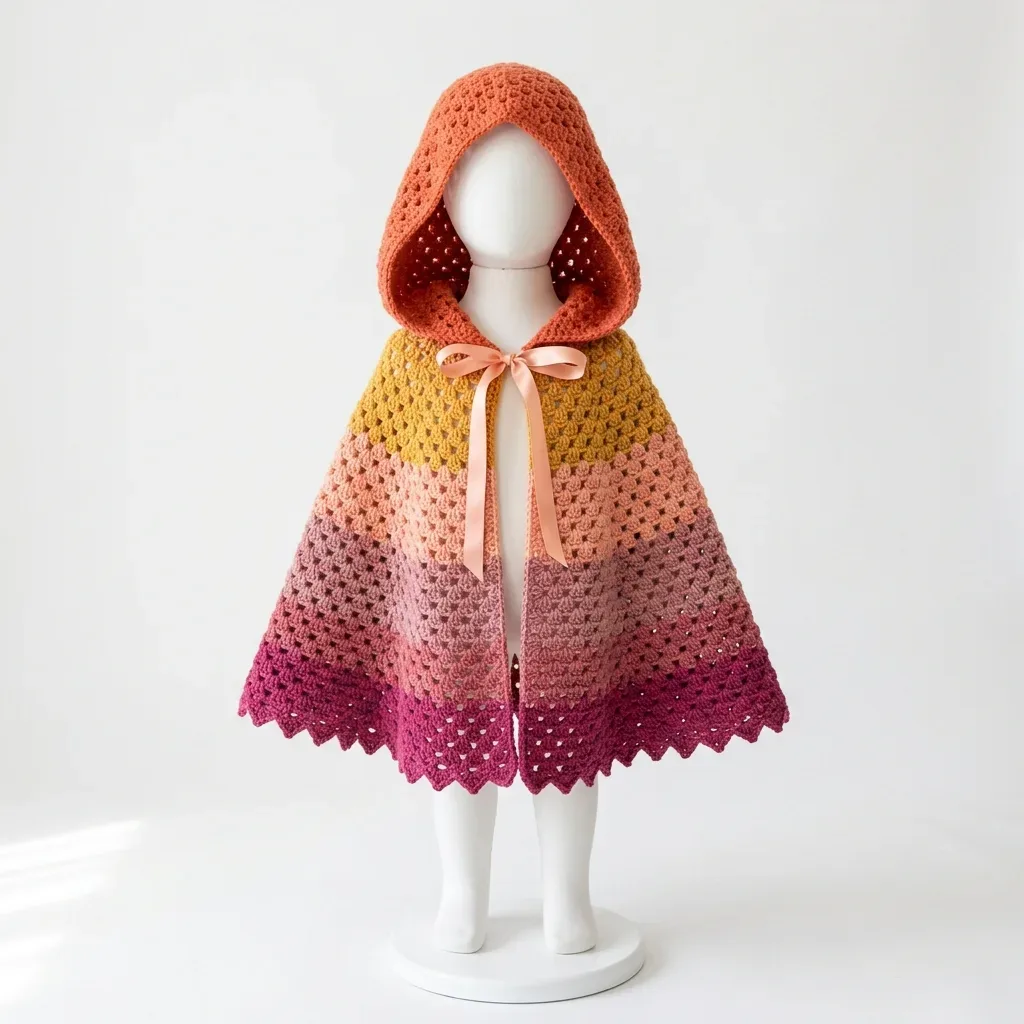
Six-color ombre hooded cape worked top-down in rounds

J-10 / 6.0 mm hook, worsted weight: a top-down hooded cape in six shifting colors with ribbon closure.

Six-color ombre hooded cape worked top-down in rounds
IntermediateLevel
8-12 hoursTime
6.0 mmHook
WorstedYarn
Jump to the pattern

About this pattern

A worsted-weight hooded cape worked top-down in joined rounds from a 36-cluster neckline, flaring outward with cluster and shell stitches across six color changes. The hood works flat in rows, seams at the top, and attaches last. Materials run about 900 yards across six colors on a J-10 / 6.0 mm hook, with ribbon drawn through the neckline for closure.

This hooded cape starts at the neckline and works outward in joined rounds, so the body grows directly from a 36-cluster-unit foundation with no seaming between pieces. The hood works flat in rows, then folds and seams along the top before it attaches to the neck edge. Six colors change every 2 to 3 rounds, and a ribbon threads through the neckline for closure. The count that matters most: 36 CU plus one ch-2 gap, the base every later increase round multiplies from.

The pattern

Written out round by round

Materials

  • Lion Brand Pound of Love works beautifully here. It’s 100% premium acrylic, machine washable, and perfect for children’s garments.
  • Paintbox Yarns Simply DK used doubled creates a worsted-weight equivalent with excellent color options.
  • Cascade 220 Superwash gives you gorgeous stitch definition if you prefer working with wool.
  • Whatever you choose, avoid fuzzy or highly textured yarns. The granny cluster detail will get lost in the fuzz.

Yarn

  • Worsted weight (weight 4), approximately 900 yards (823 meters) total across all six colors

Here’s the breakdown by color

  • Color A (burnt orange): 120 yards (110 meters)
  • Color B (golden yellow): 130 yards (119 meters)
  • Color C (warm peach-gold): 130 yards (119 meters)
  • Color D (soft peach): 130 yards (119 meters)
  • Color E (dusty rose): 130 yards (119 meters)
  • Color F (fuchsia-magenta): 160 yards (146 meters)

Hook

  • US size J-10 / 6.0 mm

Notions

  • 1 yard (1 meter) satin ribbon, approximately 5/8 inch (16 mm) wide, in peach or a coordinating color
  • Yarn needle for weaving ends and seaming
  • Scissors
  • 4 stitch markers
  • Rust-proof pins for blocking

Abbreviations

  • ch = chain
  • sl st = slip stitch (insert hook, yarn over, pull through both loops)
  • sc = single crochet (insert hook, yarn over, pull up loop, yarn over, pull through both loops)
  • dc = double crochet (yarn over, insert hook, yarn over, pull up loop, yarn over, pull through 2 loops, yarn over, pull through remaining 2 loops)
  • sp = space
  • ch-sp = chain space
  • rep = repeat
  • sk = skip
  • st(s) = stitch(es)
  • RS = right side
  • WS = wrong side
  • yo = yarn over
  • cl = cluster (special stitch defined below)
  • CU = cluster unit (one cluster plus its following ch-1 space)
  • t-ch = turning chain

Hood Foundation

With Color A, ch 37.

Round 1(WS): Dc into 4th ch from hook (beginning ch-3 counts as first dc). Dc into each ch across. Turn. (35 dc)Ch 3 (counts as first dc of first cluster throughout). Work 2 more dc into the ring to complete first cluster. Ch 1. [Work 1 cl into the ring, ch 1] 19 times. Sl st into the top of the beginning ch-3 to join. (20 CU)All 20 clusters go into the center of the ring, not into individual chains. This creates your tight neckline foundation.
Round 2(RS): Ch 3 (counts as first dc). Dc into each dc across. Dc into top of t-ch. Turn. (35 dc)Sl st into the first ch-1 sp. Ch 3, 2 dc into same ch-1 sp (first cl made). Ch 1. [1 cl into next ch-1 sp, ch 1] 19 times. Sl st to join. (20 CU)
Round 3through 18: Repeat Row 2. Do not change stitch count. (35 dc each row) After Row 18, your hood panel should measure approximately 9 inches (23 cm) wide and 9 inches (23 cm) tall.From this point forward, you’ll work with a ch-2 gap at center front on every round. This gap creates the open front of the cape.Sl st into first ch-1 sp. Ch 3, 2 dc in same sp, ch 1 (first cl made). [(1 cl, ch 1, 1 cl) into next ch-1 sp, ch 1] 4 times. [1 cl into next ch-1 sp, ch 1] 10 times. [(1 cl, ch 1, 1 cl) into next ch-1 sp, ch 1] 4 times. [1 cl into next ch-1 sp, ch 1] to last sp before gap. Ch 2 (front gap). Sl st to join into top of beginning ch-3. (28 CU plus 1 ch-2 gap)

Foundation Chain

Round 1With Color A and your J-10 hook, chain 60. Being careful not to twist, slip stitch into the first chain to form a ring.
Round 2Sl st into first ch-1 sp. Ch 3, 2 dc in same sp, ch 1. [1 cl into next ch-1 sp, ch 1] across to first marked increase sp. (1 cl, ch 1, 1 cl) into marked sp, ch 1. Continue in pattern around, placing (1 cl, ch 1, 1 cl) into every 7th ch-1 sp 4 times total. Work 1 cl with ch 1 into each remaining sp. Ch 2 at front gap. Sl st to join. (36 CU plus ch-2 gap)Checkpoint: After Round 4, your neckline should measure approximately 14 inches (35.5 cm) around the outer edge.(2)

Color Change Schedule

Change colors at the beginning of the specified round: Rounds 1 to 3: Color A (burnt orange)

Rounds 4 to 5: Color B (golden yellow)

Rounds 6 to 8: Color C (warm peach-gold)

Rounds 9 to 11: Color D (soft peach)

Rounds 12 to 14: Color E (dusty rose)

Rounds 15 to 20: Color F (fuchsia-magenta) When changing colors, work the last yarn over of the last stitch with the new color for a clean transition.

Hood Seaming

Fold the hood panel in half with right sides together so the two short ends align. Seam across the top using a yarn needle and Color A with whipstitch or mattress stitch. Turn right side out. The seam runs along the top of the head.

Hood Edging

With RS facing, Color A, and J-10 hook, join yarn at the bottom left corner of the hood opening.

Round 1Edging Round 1: Ch 1. Work sc evenly around the face opening of the hood (approximately 60 sc). Sl st to join.(60)
Round 2Edging Round 2: Ch 1. Sc into each sc around. Sl st to join. Fasten off.

Attaching the Hood

Pin the base edge of the hood evenly to the neckline of the cape body, centering the hood at the back. The front edges of the hood align with the front edges of the cape opening. Using Color A and a yarn needle, seam the hood to the cape neckline with mattress stitch.

Assembly

Step 1Weave in all ends securely, especially at color joins.
Step 2For acrylic yarns, wet blocking works best. Soak the finished cape in cool water for 20 minutes. Gently squeeze out water without wringing. Roll in a clean towel and press to remove excess moisture. Lay flat on a blocking mat and pin to finished dimensions. Allow to dry completely before unpinning.
Step 3For wool or wool-blend yarns, steam blocking with a damp pressing cloth is preferable.

Tester's notes

4 stitch markers mark the increase points in the Foundation Chain round; place them before working the round, since increases land every 7th ch-1 sp.

J-10 / 6.0 mm is the only hook size called for; change it only to correct the Round 4 measurement, not for comfort.

6 color changes happen at fixed round numbers (1-3, 4-5, 6-8, 9-11, 12-14, and beyond); weave in the join tail before working the next round locks it in place.

Fuzzy or heavily textured yarn hides the cluster definition wherever clusters replace dc, so a smooth worsted shows the pattern better.

900 yards splits unevenly across six colors, from 120 to 160 yards each; wind Color F separately, since it carries the largest single-color amount.

At a glance

Rounds7
Parts6
LevelIntermediate
Time8-12 hours
Hook6.0 mm
YarnWorsted

Gauge check

After Round 4, lay the neckline flat and measure straight across the outer edge; it should read approximately 14 inches (35.5 cm).

Stitch-count checkpoints

  • Hood Foundation · Round 1: 35 sts
  • Hood Foundation · Round 2: 35 sts
  • Foundation Chain · Round 2: 2 sts
  • Hood Edging · Round 1: 60 sts

If something looks wrong

The cape cups or domes instead of lying flat.
Too few increases were worked at the marked spots; recount, since increases land every 7th ch-1 sp, 4 times per round, and skipping one tightens that section.
The neckline measures off from 14 inches after Round 4.
Hook size or tension is the usual cause; redo the round with a half-size hook change rather than forcing the stitch count to match.
The hood edging sc count comes out far from 280.
Extra or missing sc usually trace to the corners; 2 sc go into each ch-2 front gap corner, and skipping that double-up undercounts the round.
Hem scallops look uneven at the corners.
The pattern allows adjusted spacing at corners to keep the 46 hem shells balanced; shift the skip count by one sc on either side instead of forcing exact 2-sc skips.

Yarn substitutions

Fingering-weight wool held doubledApproximates worsted gauge with more drape; drop to a US H-8 / 5.0 mm hook and expect total yardage to shift since doubled strands cover ground faster.
DK-weight cotton-acrylic blendProduces a stiffer cape with sharper cluster definition; keep the J-10 / 6.0 mm hook but swatch first, since cotton blends run tighter at the same hook size.
Bulky-weight acrylic, single strandCuts total yardage well under 900 yards but softens stitch definition in the clusters; move up to a K-10.5 / 6.5 mm hook and expect a shorter, stiffer drape.
FAQs

Questions

Can the cape be made in fewer than six colors?

Yes, since the color change schedule only sets round numbers, not a required color count. Repeating one or two colors across the assigned rounds still produces the same 36-CU structure and finished size.

Does the hood get worked at the same time as the body?

No. The hood is a separate piece worked flat in rows from a ch-37 foundation, then folded and seamed along the top before it attaches to the neckline during assembly.

What happens if the increase points land in the wrong spot?

The round total of 36 CU plus the ch-2 gap will be off, and the flare will skew unevenly instead of spreading around the cape. Mark increase spots with the 4 stitch markers before starting the round so every 7th ch-1 sp is counted correctly from the join.

One at a time —

Get the next pattern

Tested round by round before it is sent. No spam.