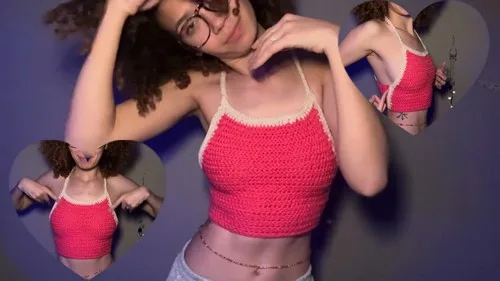
Made and counted by Wren —

Side stripe crochet top with criss-cross back straps

4mm hook, Weight 4 yarn make this side-stripe crochet top with criss-cross straps and contrast HDC border.

Side stripe crochet top with criss-cross back straps
BeginnerLevel
4-6 hoursTime
4 mmHook
WorstedYarn
Jump to the pattern

About this pattern

This is a flat crocheted top worked in half double crochet, starting with about 30 chains across the collarbone and shaped with paired increases on the following row. A contrast-color border adds two HDC rows along each side and top edge, and 175-chain straps worked back in HDC form the criss-cross back. A 4mm hook and Weight 4 yarn complete it.

A single flat collar panel, started with roughly 30 chains across the collarbone, builds this top: half double crochet fills the body, a contrast-color border adds two HDC rows on every edge for the stripe, and 175-chain straps crisscross at the back. The 30-chain start is the number to get right — it sets how the whole panel sits across the shoulders before any border or strap gets added.
The pattern

Written out round by round

Materials

  • 4 mm crochet hook
  • Weight 4 yarn
  • Scissors

Abbreviations

  • hdc = half double crochet

Collar

Chain your desired width for the collarbone area (approx. 30 chains recommended).

Row Instructions

Round 1Half double crochet (HDC) in each chain. For Row 2: Place 2 HDC in the first stitch.HDC across.Place 2 HDC in the last stitch.
Rounds 3–10Alternate between regular HDC rows and increase rows (as in Row 2). You should end with 5 regular and 5 increase rows, creating a slanted neckline.
Rounds 11–30HDC in each stitch (no increases). Side Border (Contrast Color) Attach border color yarn (e.g., white) to one corner.HDC down the side of the rows.Repeat for a second row to thicken the border.

Mirror the process on the other side for symmetry.

Top Border HDC along the top edge of the piece.

Work a second row of HDC for a clean finish.

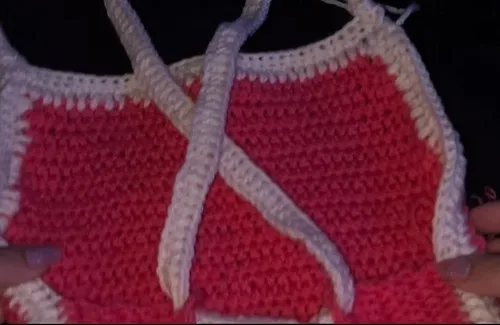
Straps Slip knot and slip stitch into a top corner.

Chain desired strap length (approx. 175 chains for criss-cross style).

HDC back down the chain.

Slip stitch the end into the border to secure.

Repeat for the second strap.

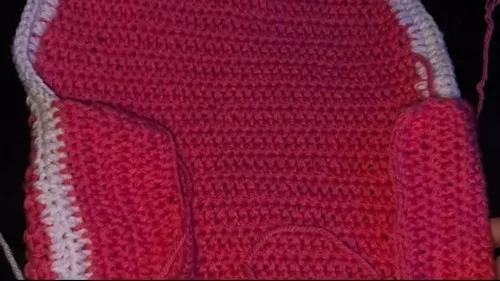
Bottom Half Using your main color yarn, HDC from the bottom corner along the white border.

Crochet 15 rows (half of the 30-row top length).

Assembly

Step 1Weave in all loose yarn ends for a clean, polished look.

Tester's notes

4mm hook with Weight 4 yarn is the pairing the border and strap rows are sized for; swapping either changes the chain counts below.

30 chains is a recommended collarbone width — measure the chain against the body before Row 1, since Row 2's increases depend on this count being even.

2 HDC placed at the start and end of Row 2 flare the panel; count stitches after that row to confirm both ends gained exactly one stitch.

175 chains for strap length is approximate — lay the chain across the back before working HDC back down it, since criss-cross straps show any length mismatch immediately.

Border color yarn attaches at a corner and carries two HDC rows per edge; weave that starting join in tight so it doesn't loosen under the second row.

Work in progress

Side stripe crochet top with criss-cross back straps — photo 2
Side stripe crochet top with criss-cross back straps — photo 3

At a glance

Rounds3
LevelBeginner
Time4-6 hours
Hook4 mm
YarnWorsted

Gauge check

The pattern gives chain counts, not a swatch gauge, so after the first HDC row lay the panel flat and compare its width to the 30-chain starting measurement across the collarbone.

If something looks wrong

the collar panel curls instead of lying flat
Uneven tension or a missed increase at Row 2's ends pulls the fabric; recheck that both ends gained the 2 HDC increase and loosen tension on the following rows.
the contrast border looks thin after finishing it
A skipped second HDC row leaves only a single thin line of color; work the second row directly into the first row's stitches along that same edge.
the criss-cross straps twist or sit unevenly
Uneven chain length between the two 175-chain straps causes the twist; lay both chains flat side by side before working HDC back down them and re-chain any that don't match.
one side border is visibly wider than the other
The mirrored second side wasn't checked stitch for stitch against the first; count both sides' two HDC rows against each other before weaving in ends.

Yarn substitutions

Cotton, Weight 4 (worsted)Keeps the 4mm hook and the pattern's chain counts as written; stitch definition on the HDC border sharpens, drape stays close to the original.
Acrylic-cotton blend, Weight 4 (worsted)Still works with a 4mm hook and the same chain counts; drapes lighter than pure cotton, so the 175-chain straps hang with less pull on the shoulders.
Bamboo-rayon blend, Weight 3 (DK)Thinner than the pattern's Weight 4; drop to a 3.5mm hook and retest the 30-chain and 175-chain counts against the body, since a lighter yarn shrinks the finished width.
FAQs

Questions

Why is 30 chains only a recommendation for the collar, not a fixed count?

Collarbone width varies by body, so 30 chains is a tested starting point rather than a fixed rule. Measure the chain across the collarbone before working Row 1, and adjust in even numbers so Row 2's increases stay symmetrical on both ends.

Can the strap chain be shorter than 175 stitches?

Yes. Lay a shorter test chain across the back before committing, then work HDC back down it as instructed; a shorter chain simply changes how far the straps cross at the back.

Why does the border need two full HDC rows on every edge?

The first HDC row shapes the edge, and the second row stacked on it is what gives the contrast stripe its visible thickness. One row alone leaves a thin line of color that doesn't match the bold stripe the pattern is built around.

One at a time —

Get the next pattern

Tested round by round before it is sent. No spam.