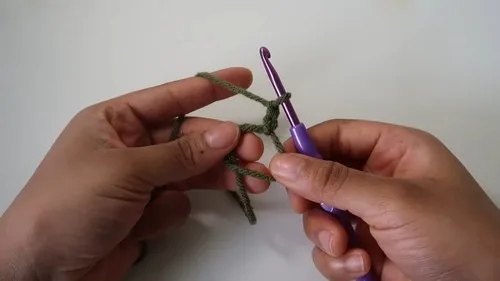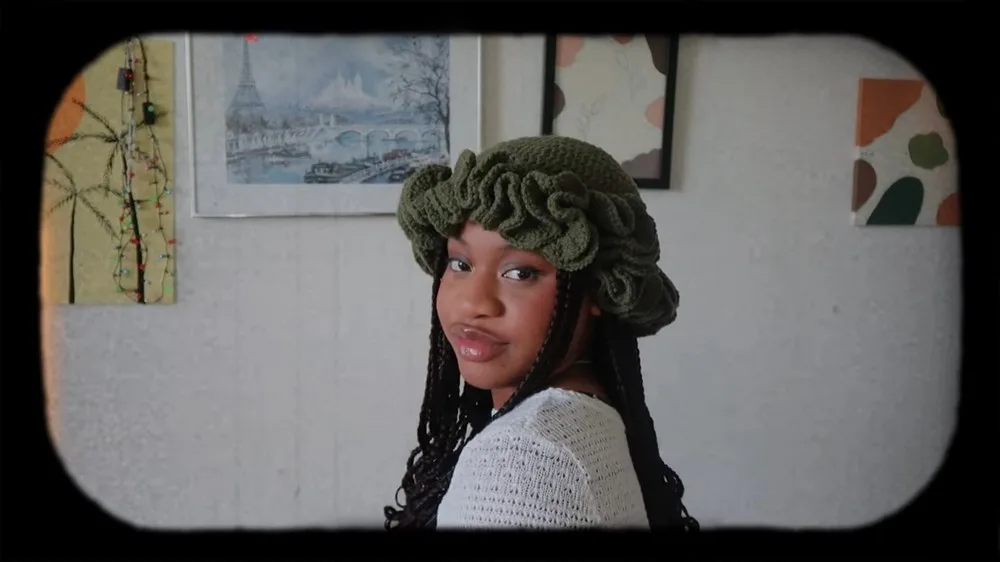
Made and counted by Wren —

Ruffle hat crochet pattern for cold-weather wear

4.5mm hook, worsted weight 4 yarn: a 5-round ruffle hat pattern with a doubling stitch count.

Ruffle hat crochet pattern for cold-weather wear
IntermediateLevel
4-6 hoursTime
4.5 mmHook
WorstedYarn
Jump to the pattern

About this pattern

A 5-round crochet hat worked with worsted weight 4 acrylic yarn and a 4.5 mm hook. Construction relies on doubling increases: round 2 finishes at 20 dc, round 3 at 30 stitches, building the ruffled edge that defines the piece. A stitch marker tracks round starts. No assembly steps; the hat is a single continuous piece.

This hat builds outward in worked rounds, not up in rows, using a doubling increase to push the fabric into a ruffled edge. Round 2 doubles every stitch to reach 20 dc; round 3 doubles again in a spaced sequence to hit 30 stitches. Five rounds total. Worsted weight 4 acrylic and a 4.5 mm hook keep the fabric dense enough to hold its shape without stiffening it.
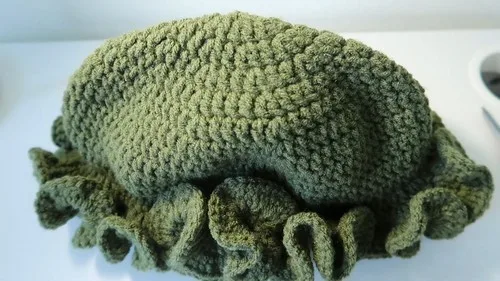
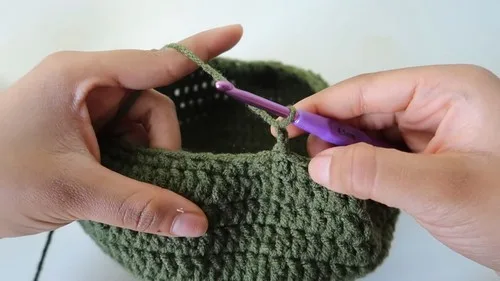
The pattern

Written out round by round

Materials

  • Acrylic yarn, weight 4 (Brand: Loops and Threads)
  • Crochet hook size 4.5 mm
  • Scissors
  • Stitch marker

Abbreviations

  • st = stitch
  • sl st = slip stitch
  • dc = double crochet

Main Pattern

Round 2Chain 2 to start a new row. Place two double crochets in each stitch around (2 dc in each dc).(2)

You will end up with 20 dc at the end of this row.

Sl st into the first dc to close off the row.

Round 3Chain 2. Double crochet into the first stitch, then place two double crochets into the next stitch.Repeat from to around, following this sequence until you complete the row for a total of 30 stitches.Sl st to close.

In Row 4: Chain 2.

Two double crochets in each of the next two stitches, then two double crochets in the third stitch.

Repeat from to around.

Sl st into the first dc to close the row.

Round 5Chain 2. Make three double crochets, then increase in the fourth stitch (two dc in the same stitch).Repeat from to around until end.Continue this pattern and complete rows until you have a total of eight rows.
Round 9to 12: Chain 2. Continue with one double crochet in each stitch around for four rows.No increasing or decreasing, just plain double crochets.

In Row 13 (Decreasing Row): Chain 1.

For decreasing, insert hook into the stitch, yarn over, pull through, then insert into the next stitch, yarn over, pull through, and yarn over and pull through all three loops on the hook.

Repeat from to around for all stitches.

Sl st into the first stitch to close the round.

Round 14to 16: Chain 2. In every stitch, place three double crochets to create ruffles. Repeat from to around each stitch.Repeat the ruffle pattern for three total rows.Finish by slip stitching and cutting the yarn to secure.

Tester's notes

4.5 mm hook: check it against the yarn label range for worsted weight 4 before starting, since a smaller hook tightens the ruffle and a larger one loosens it.

Stitch marker: move it to the first stitch of each new round immediately after the chain 2, not after the first double crochet, to keep the round count accurate.

20 dc at the end of round 2 is the checkpoint that catches missed increases early; recount before moving to round 3.

30 stitches at the end of round 3 confirms the spaced increase sequence was followed correctly; a miscount here compounds in later rounds.

Chain 2 at the start of each round counts as the turning chain, not a stitch to work into on the return join; slip stitch into the first actual dc to close.

Work in progress

Ruffle hat crochet pattern for cold-weather wear — photo 2
Ruffle hat crochet pattern for cold-weather wear — photo 3
Ruffle hat crochet pattern for cold-weather wear — photo 4

At a glance

Rounds5
LevelIntermediate
Time4-6 hours
Hook4.5 mm
YarnWorsted

Gauge check

After round 2, count stitches around the join point; the round should land at exactly 20 dc before starting round 3.

If the count is off, unravel back to the slip stitch and re-work the increases rather than adjusting later rounds to compensate.

If something looks wrong

The round count comes up short of 20 dc after round 2.
A stitch was skipped instead of doubled somewhere in the round. Unravel to the join and re-work round 2, placing two dc in every single stitch with no exceptions.
The round count exceeds 30 stitches after round 3.
The increase sequence was applied to more stitches than intended. Recheck the repeat pattern of round 3 against the stitch marker and rework from the last confirmed count.
The piece cups instead of lying flat after the early rounds.
The doubling increases are running behind schedule for the round. Confirm the 20 dc and 30-stitch checkpoints exactly; a shortfall in either round causes cupping in the rounds that follow.
The fabric ruffles unevenly around the join.
The slip stitch closing each round was worked into the wrong stitch, shifting the increase pattern off-center. Use the stitch marker to confirm the first dc of the round before closing with the slip stitch.

Yarn substitutions

Wool, weight 4 (worsted)Same 4.5 mm hook works without adjustment; the fabric gains loft and warmth, and the ruffle edge holds its shape with less blocking.
Cotton, weight 4 (worsted)Drape increases and the ruffle relaxes more than with acrylic; sizing up to a 5.0 mm hook can restore the original stitch density.
Acrylic-wool blend, weight 4 (worsted)Closest match to the original fiber; hook size stays at 4.5 mm and stitch counts (20 dc, 30 stitches) transfer without recalculation.
FAQs

Questions

Why does round 3 end at 30 stitches instead of doubling to 40 like round 2?

Round 3 uses a spaced increase sequence, doubling only some stitches instead of all of them. That spacing is what produces the 30-stitch count and starts shaping the ruffle rather than a flat doubling.

Does the 4.5 mm hook size matter if a different worsted weight 4 yarn is used?

It matters for matching the 20 dc and 30-stitch checkpoints exactly. If the substitute yarn is thinner or thicker than the original, size the hook up or down until the stitch counts land on target.

What happens if a stitch marker is not used during the increase rounds?

Losing track of the round start makes it easy to misplace the slip stitch closure, which throws off the 20 dc and 30-stitch counts. A marker on the first stitch of each round is the fastest way to keep those counts accurate.

One at a time —

Get the next pattern

Tested round by round before it is sent. No spam.