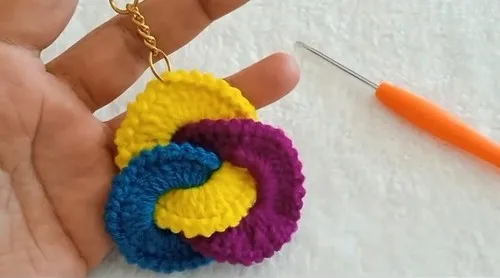
Made and counted by Wren —

Three-color interlocking ring keychain pattern

2.5 mm hook, three colors of yarn. Interlocking dc rings joined into one keychain.

Three-color interlocking ring keychain pattern
IntermediateLevel
4-6 hoursTime
2.5 mmHook
WorstedYarn
Jump to the pattern

About this pattern

This is a three-ring interlocking keychain worked in double crochet with a 2.5 mm hook, one color per ring. Each ring starts as a 15-chain circle, builds to 35 dc in round 2, then gets a slip-stitch-and-chain border in round 3. Rings join to each other through their base chains as they're made, then a keyring attaches to one finished ring.

Three double crochet rings, each in a different color, interlock into one chain-and-dc keychain. Ring 1 stands alone; Ring 2 joins to Ring 1 at the base chain; Ring 3 joins through both previous bases, locking all three together. Each ring carries 35 dc around its round 2, so the count that matters most is 35 — check it before starting the border round on every ring.
The pattern

Written out round by round

Materials

  • Three different colors of yarn
  • 2.5 mm crochet hook
  • Scissors
  • Keyring

Abbreviations

  • ch = chain
  • dc = double crochet
  • sl st = slip stitch

First Ring

Use your first yarn color.

Finish off and cut the yarn.

Round 1Make a slip knot and chain 15; join the ends with a slip stitch to form a circle.
Round 2Chain 3 to start the round; work 35 double crochet stitches around the circle; join with a slip stitch to close the round. (35 dc)
Round 3Chain 1, then alternate: slip stitch in next stitch, chain 1; repeat around for decorative border.

Second Ring

Use your second yarn color.

Finish off, cut yarn, and weave in ends.

Round 1Make a slip knot and chain 15; join this new chain to the first ring by slip stitching into its first chain.
Round 2Chain 3 to start; work 35 double crochet stitches around the new ring; join with a slip stitch. (35 dc)
Round 3Add border: slip stitch, then chain 1 in each stitch around.

Third Ring

Use your third yarn color.

Finish off and cut yarn securely.

Round 1Make a slip knot and chain 15; interlock with both previous rings by joining with a slip stitch through their bases.
Round 2Chain 3, then work 35 double crochets around the new ring; join with a slip stitch to close. (35 dc)
Round 3Add border with alternating slip stitch and chain stitch.

Assembly

Step 1Attach your keyring to one of the completed rings.
Step 2Optionally, seal the yarn ends with a lighter for a cleaner finish.

Tester's notes

1. Use the same 2.5 mm hook for all three rings — a size change between rings shows up as a visible gap where they interlock.

2. 35 dc is the target for round 2 on every ring; miscounting here is the most common reason a ring won't lie flat.

3. Join each new ring's chain-15 to the previous ring's base chain before closing round 1 — this is what locks the three rings together, not the border round.

5. Weave in ends after the Second Ring specifically, since the pattern calls it out there — leaving it for the end makes three sets of ends harder to sort by color.

Work in progress

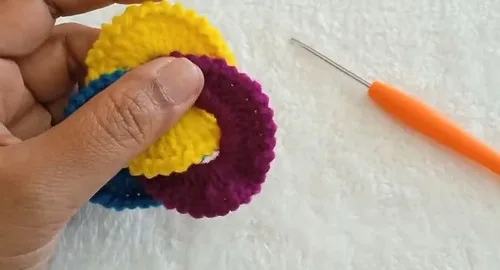
Three-color interlocking ring keychain pattern — photo 2
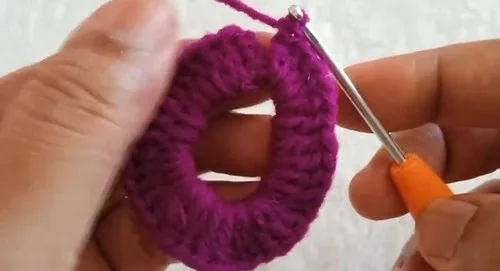
Three-color interlocking ring keychain pattern — photo 3

At a glance

Rounds9
Parts3
LevelIntermediate
Time4-6 hours
Hook2.5 mm
YarnWorsted

Gauge check

After round 2 of the First Ring, count stitches around before closing: 35 dc should sit flat without the circle cupping or rippling.

If the count is off or the ring buckles, undo back to the join and adjust hook size or tension rather than forcing the border round over a bad base.

Stitch-count checkpoints

  • First Ring · Round 2: 35 sts
  • Second Ring · Round 2: 35 sts
  • Third Ring · Round 2: 35 sts

If something looks wrong

The ring cups instead of lying flat after round 2.
35 dc is too tight or too loose for the 15-chain base. Recount stitches around; if the number is right but it still domes, size up or down a half hook size and redo the round.
The rings won't interlock — they sit
The new ring's chain wasn't slip-stitched through the previous ring's base before round 1 was closed. Reopen the join and slip stitch through the actual base chain, not just near it.
The round 3 border looks uneven
The alternating slip stitch/chain-1 pattern was worked at inconsistent tension. Keep each slip stitch snug and each chain-1 the same loose length all the way around.
The chain-15 circle at round 1 twists
The chain got a half-twist before the slip stitch closed it. Lay the chain flat on a table and check both ends align before slip stitching the circle shut.

Yarn substitutions

Cotton, worsted weightStiffer fabric, holds the 35-dc ring shape without blocking; keep the 2.5 mm hook, no stuffing involved either way.
Acrylic, worsted weightClosest match to a typical worsted-weight default; drape stays soft, 35-dc count and 2.5 mm hook need no adjustment.
Cotton-acrylic blend, DK weightThinner fiber means the same 35 dc produces a smaller ring; drop to a 2.0-2.25 mm hook to keep the fabric from gapping.
FAQs

Questions

Do the three rings have to be joined in order, First then Second then Third?

Yes. Ring 2 joins to Ring 1's base chain, and Ring 3 joins through both Ring 1 and Ring 2's bases. Working out of order leaves the interlock incomplete.

Which ring should the keyring attach to?

The pattern doesn't specify one ring over another — any of the three completed rings works, since assembly only calls for attaching to 'one of the completed rings.' Pick whichever ring sits at the outer edge of the finished chain for easiest keyring access.

Is sealing the yarn ends with a lighter necessary?

No, it's listed as optional in the assembly steps. Weaving in ends (called out specifically after the Second Ring) is sufficient; the lighter step is only for a cleaner cut-end finish.

One at a time —

Get the next pattern

Tested round by round before it is sent. No spam.