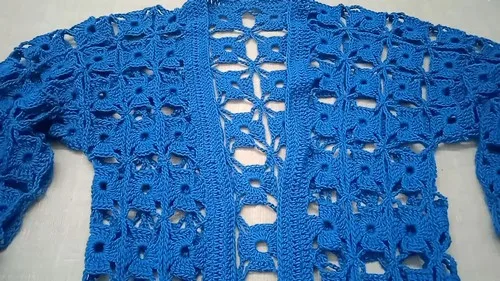
Made and counted by Wren —

Lace flower motif bolero cardigan for every season

3.5mm hook, 6-ply cotton: flower-motif lace bolero cardigan built from two joined foundation panels.

Lace flower motif bolero cardigan for every season
IntermediateLevel
10-14 hoursTime
3.5 mmHook
WorstedYarn
Jump to the pattern

About this pattern

A flower-motif lace bolero worked as two matching 4-round foundation panels in 6-ply cotton on a 3.5 mm hook, joined by chain-8 and chain-4 loops into 3-petal clusters of 5 trc each. Armholes form by leaving 6 flowers unworked at both ends of the center section; sleeves work in the round and close as a tube. One panel extends by two rows to become the back.

This bolero cardigan builds from two identical foundation-motif panels, each four rounds of 3-petal flowers worked in 5-trc clusters joined by chain-8 and chain-4 loops. The two panels seam at the shoulders and sides, with 6 flowers left unworked on both ends of the center section to mark each armhole. Sleeves pick up around that opening and work in the round to length, then close as a tube. One panel gains two extra rows of flowers before joining to form the back piece. 300 g of 6-ply cotton on a 3.5 mm hook covers both panels and the sleeves.
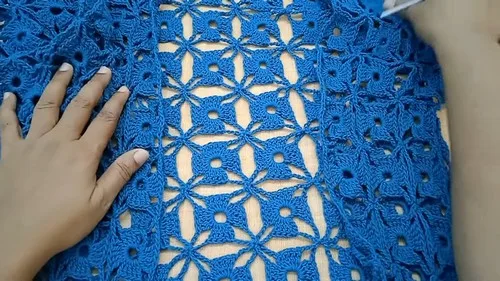
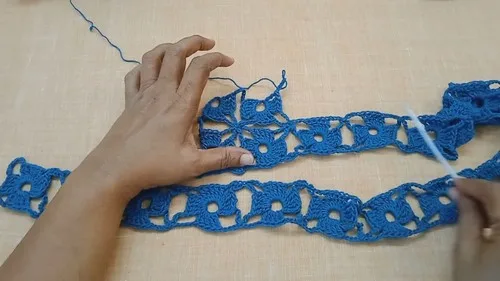
The pattern

Written out round by round

Materials

Yarn

  • 6-ply 100% cotton yarn (approximately 300g)

Hook

  • 3.5 mm hook

Abbreviations

  • ch = Chain
  • sl st = Slip Stitch
  • trc = Triple Crochet

Main Pattern (Foundation Motif)

Make 2

The lace is made from square motifs, each with four petals.

Round 1Forward Pass: Starting the First Flower Chain 9, slip stitch to form a ring; Chain 4 (counts as the first trc), then work 4 more trc into the ring (Total 5 trc); Chain 8; Work 5 trc into the ring; Chain 8; Work 5 trc into the ring; end of the first 3-petal motif.
Round 2(Forward Pass: Starting a New Flower Unit and Joining): Chain 22; Sl st into the 9th chain from the hook; Sl st 5 more chains; Work 5 trc into the 9-chain loop; Chain 4; Sl st into the 4th chain of the previous flower's 8-chain loop; Chain 4; Work 5 trc into the current flower's ring; Chain 8, then work 5 trc into the current flower's ring; Repeat until the required length is achieved.
Round 3Return Pass: Completing the First Row Chain 8, work 5 trc into the ring of the last flower; Chain 4; Sl st into the 4th chain of the next 8-chain loop from the row below; Chain 4; Work 5 trc into the next flower's ring; Repeat the process until you reach the beginning of the row.Repeat the two-pass method (Forward Pass and Return Pass) for subsequent rows, joining the new flowers to the corners/junctions of the flowers in the previous row.
Round 4(Forward Pass: Starting Row 2): Chain 22; Sl st and work the first 5 trc into the ring; Chain 4; Sl st into the corner junction of the previous row; Chain 4; Work the second 5 trc into the ring; Repeat the process until you make a strip of 3-petal motifs, joining at all available junctions.Repeat the Forward and Return Passes until the desired length is reached.Make a second piece the same as the first.

Assembly

Step 1Mark the armhole area (leaving 6 flowers unworked on both ends).
Step 2Work the flower pattern across the center section, joining to the foundation row as you go.
Step 3Work the sleeve in the round for the desired length.
Step 4Close the sleeve tube by completing the final petal and joining to the starting point of the round.
Step 5Extend one of the pieces with two additional rows of flowers for the back piece.
Step 6Join the flower loops to the corresponding shoulder/back edge using the ch 4, join, ch 4 technique.
Step 7Join the side seams of the sleeve and body using slip stitch or single crochet.
Step 8Work two rows of double crochet (dc) along the front opening and neckline.
Step 9Work one row of double crochet (dc) along the bottom hem.

Tester's notes

3.5 mm hook holds the 6-ply cotton loose enough for the trc clusters to fan into flat petals; a smaller hook tightens the ring and closes the 8-chain loops needed for joining later rows.

300 g of yarn covers both foundation-motif panels plus both sleeves; weigh the yarn remaining after the first panel to confirm the second panel will finish at the same length.

Mark the 6 flowers left unworked at each armhole end before starting the center section so the joining count does not drift row to row.

5 trc into each ring is the fixed petal count on every round; miscounting here throws off every chain-4 corner join in the rows that follow.

Cotton has no stretch recovery, so keep the chain-8 and chain-22 starting chains at even tension throughout - loose chains show as sagging petals once the piece hangs on the body.

Customize the size, add sleeves, or experiment with different yarn colors to make the cardigan uniquely yours; the square-motif construction works with any 6-ply cotton color choice.

Work in progress

Lace flower motif bolero cardigan for every season — photo 2
Lace flower motif bolero cardigan for every season — photo 3

At a glance

Rounds4
LevelIntermediate
Time10-14 hours
Hook3.5 mm
YarnWorsted

Gauge check

Measure the diameter of the first 3-petal motif after round 1: petals should sit flat against each other with the chain-8 loops relaxed, not cupped or gapping open.

If the motif cups inward, drop to a smaller hook; if the chain-8 loops pull short and won't lie flat, go up a hook size before starting round 2.

If something looks wrong

The petals cup instead of lying flat.
The 5 trc worked into the ring are pulling too tight; loosen tension on that round or move up a hook size for the foundation rounds.
Flower rows don't line up at the joins.
The chain-4 join missed the 4th chain of the previous 8-chain loop; recount to the 4th chain specifically, not the 3rd or 5th, before slip stitching in.
The sleeve tube puckers where it closes.
The final petal wasn't joined back to the round's starting point at the same chain count as the rest of the round; unpick the last join and match it to the opening chain.
The center section comes up short of the armhole marks.
Fewer than 6 flowers were left unworked on one end; count flowers in from the edge on both sides before starting the sleeve pickup.

Yarn substitutions

Fingering-weight mercerized cottonPetals shrink and drape softens; drop below the 3.5 mm hook to keep the 5-trc clusters closed, and the 300 g equivalent will cover more rows of flowers.
Worsted-weight cotton-linen blendPetals enlarge and the fabric holds its shape stiffer; move up to a 4-4.5 mm hook, and expect the yardage to cover fewer rows than the original 300 g plan.
DK-weight cotton-acrylic blendOverall piece lightens and softens for easier care; the 3.5 mm hook range still works, but check the round 1 motif diameter since blended fiber behaves differently than 100% cotton at the same hook size.
FAQs

Questions

How many flowers form each armhole opening?

6 flowers stay unworked on both ends of the center section before the sleeve starts. That gap becomes the armhole once the sleeve is picked up and worked in the round from its edge.

Why does the pattern call for two separate panels instead of one piece?

Each panel is its own 4-round foundation motif; two identical panels seam together for the cardigan body while one gets two extra rows to become the back. Working them as separate pieces keeps the flower joins accurate instead of turning corners mid-motif.

Does the 300 g yardage change if the cardigan needs to run longer?

300 g covers both foundation panels and both sleeves as written, including the two extra back rows. Extending length past that point will need yarn beyond the 300 g total, so weigh a finished panel against the total to estimate the extra per added row.

One at a time —

Get the next pattern

Tested round by round before it is sent. No spam.