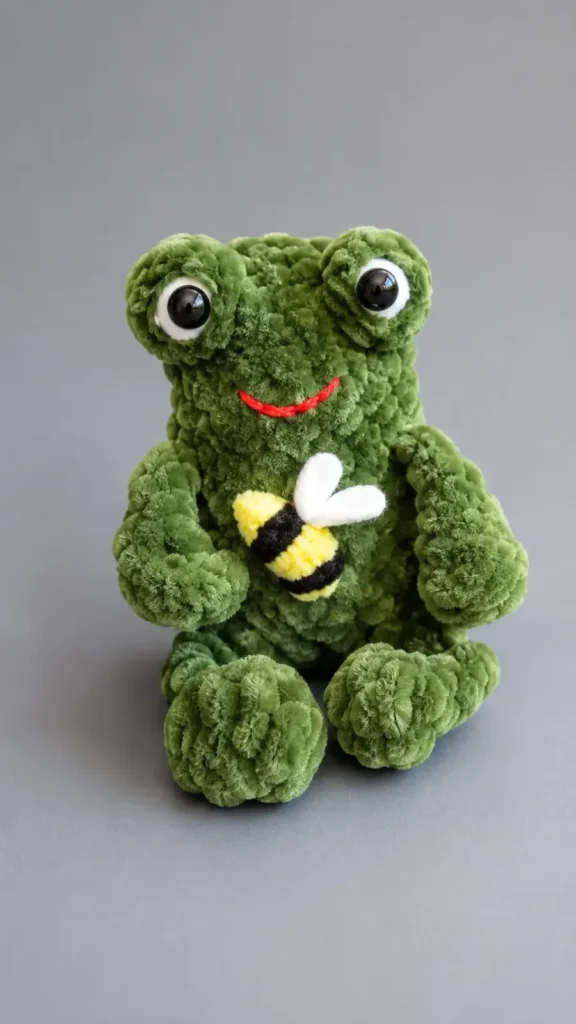
Made and counted by Wren —

Amigurumi frog plush pattern with bobble-stitch legs and eyes

3.75mm hook, worsted plush yarn: crochet a frog plush with bobble-stitch legs, glue-on eyes, and a tiny flower accent.

Amigurumi frog plush pattern with bobble-stitch legs and eyes
IntermediateLevel
4-6 hoursTime
8 mmHook
WorstedYarn
Jump to the pattern

About this pattern

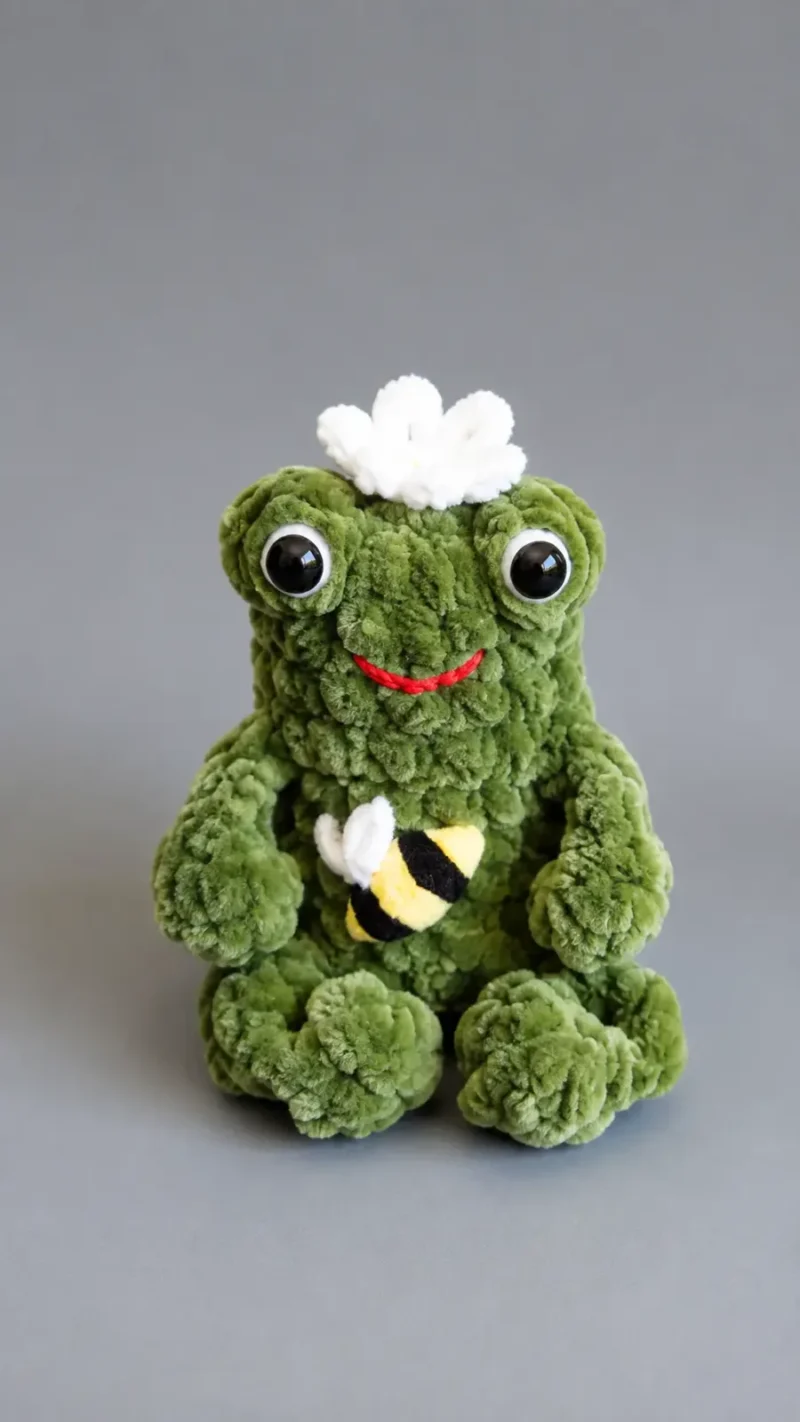
This is a one-piece amigurumi frog: body, legs, and head crochet together over 8 rounds in green plush yarn (100g/120m) on a 3.75 mm hook. Bobble stitches (3dc and 4dc variants) shape the legs and eyes as the rounds progress. A 1-round flower on 2.75 mm hook, glue-on 8 mm safety eyes, and a hand-embroidered bee finish it. Stuffing happens late, through the top opening, before the head closes.

This frog plush works as one continuous piece: body, legs, and head build from a single starting chain across 8 rounds, with bobble stitches forming both the lower/upper legs and the eyes as the piece grows. The green body uses plush yarn (100g/120m) on a 3.75 mm hook, while a separate 1-round flower and hand-embroidered bee add the only color breaks. The count that matters most is 8 — every shaping decision, leg placement, and stitch total builds off that round sequence before stuffing and closing at the top.
The pattern

Written out round by round

Materials

  • Green plush yarn ($100\text{g}/120\text{m}$)
  • Small amount of white, yellow, and black yarn for embroidering the bee
  • Any thin yarn for the flower (author used Pekhorka Children’s Novelty)
  • Thread for embroidering the mouth
  • Glue-on safety eyes 8 mm
  • Stitch marker
  • Fiberfill stuffing
  • Yarn needle
  • Crochet hook suitable for your density (author used Clover 3.75 mm for frog, Clover 2.75 mm for flower)

Abbreviations

  • ch = chain
  • sc = single crochet
  • inc = increase
  • dec = decrease
  • Bobble (lower legs and eyes) = 4 dc into one stitch with one top
  • Bobble (upper legs) = 3 dc into one stitch with one top
  • sl st = slip stitch
  • MR = magic ring

Body-Legs-Head

Round 1Make 4ch and from the 2nd chain from the hook: inc, sc, inc from 3 sc, 2 sc. (8)
Round 2inc, in one stitch crochet (sc, make 7 ch from 2nd chain from hook crochet Bobble, 5 sc, sl st into front loop of base stitch (this crocheted the first lower leg), sc), sc, inc (again crochet leg 7ch, Bobble, 5sc and sl st into front loop of base stitch), 2 inc, sc, inc. (14)
Round 33 sc up to the leg, 4 sc between legs, 7 sc after leg to end of round. (14)
Rounds 4–614 sc. (14) - 3 rounds
Round 74sc, crochet leg, make 5ch from 2nd from hook Bobble, 3 sl st and sl st into front loop of base stitch, 5sc, leg, 5sc. (14)
Rounds 8–1014 sc. (14) - 3 rounds
Round 112dec, (crochet eyes) Bobble, 2 dec, Bobble, 2dec. (8)
Round 124dec. (4) Cut thread, fasten and close opening of last round.

Flower

Round 1In MR, sl st, then (4ch and sl st in next stitch) repeated 6 times total; cut thread and fasten.

Assembly

Step 1Glue on eyes.
Step 2Embroider bee: make 3-4 stitches with yellow color, on top 2 stripes in black and embroider wings in white.
Step 3Attach flower to frog.

Tester's notes

8 mm safety eyes glue on rather than crochet in place; check placement against the head shaping before committing glue.

Keep tension consistent: Working with plush yarn can hide stitches, so feel for the top loops carefully when placing your hooks.

Stuff right before closing: Stuff the frog body through the top opening at round 11 or 12 before fully cinching the top closed.

Work bobbles neatly: Pull your bobble loops to a uniform height so the feet and eyes pop out with uniform roundness.

Use stitch markers religiously: Since plush yarn hides round beginnings easily, mark your first stitch in every single round.

Secure embroidered details well: Weave in the tail ends of your yellow, black, and white embroidery threads inside the body before closing up the top.

Work in progress

Amigurumi frog plush pattern with bobble-stitch legs and eyes — photo 2
Amigurumi frog plush pattern with bobble-stitch legs and eyes — photo 3

At a glance

Rounds9
Parts2
LevelIntermediate
Time4-6 hours
Hook8 mm
YarnWorsted

Gauge check

After Round 1, count stitches around the starting chain base and confirm 8 total before moving on.

If the count is off, do not rip back to check tension against a swatch — plush yarn hides gauge swatches — instead size the hook up or down until Round 1 lands on 8 and the fabric still closes without gaps.

Stitch-count checkpoints

  • Body-Legs-Head · Round 1: 8 sts
  • Body-Legs-Head · Round 2: 14 sts
  • Body-Legs-Head · Round 3: 14 sts
  • Body-Legs-Head · Round 11: 8 sts

If something looks wrong

A leg twists or sits at an odd angle
The slip stitch that anchors the leg back into the front loop of the base stitch was likely placed in the wrong loop. Undo just the sl st, find the correct front loop, and re-anchor before continuing the round.
The bobble eyes or feet look flat
Bobble loops (3dc or 4dc into one stitch) were pulled to uneven heights. Redo the bobble, pulling each of the dc loops to the same height before closing the top of the bobble.
Stitch count drifts away from 14 partway through the body
A stitch marker was lost or the round start was misread in the plush texture. Recount from the last confirmed round, re-place the marker at the true first stitch, and correct the count before proceeding.
The head feels soft or collapses slightly after closing
Stuffing was added too early or too sparingly before the Round 11-12 closure. Reopen the cinch if still loose enough, add more fiberfill, and close again snugly.

Yarn substitutions

Worsted-weight acrylic (non-plush)Closest stitch-count match to the original 100g/120m plush yarn on the same 3.75 mm hook, but stitch definition shows more, so bobbles and rounds read more crisply and less fuzzy.
Worsted-weight cottonFirmer fabric with less give than plush yarn, so stuffing may need to be added in smaller amounts to avoid stretching stitches; a slightly smaller hook than 3.75 mm can tighten gaps for stuffing containment.
Bulky-weight plush or chenilleProduces a larger finished frog than the 100g/120m original at the same 8 rounds, requires a hook larger than 3.75 mm, and needs more fiberfill to fill the bigger cavity.
FAQs

Questions

Can I use regular worsted weight yarn for this frog?

Yes, you can use regular cotton or acrylic yarn, but your finished frog will turn out significantly smaller.

How do I glue the safety eyes on safely?

Apply a small drop of fabric glue or craft-safe multi-purpose glue onto the back of the eye pin before inserting it firmly into the plush fabric.

Do I need to sew the legs on separately?

No, the limbs are bobbles and chains worked directly into the body rows as you go.

What hook size is best if I use fine yarn for the flower?

A 2.5 mm or 2.75 mm hook works wonderfully for working thin cotton yarn into small flower petals.

Is this pattern beginner-friendly?

Yes, it is very approachable if you are familiar with bobble stitches and working into chain tails.

One at a time —

Get the next pattern

Tested round by round before it is sent. No spam.