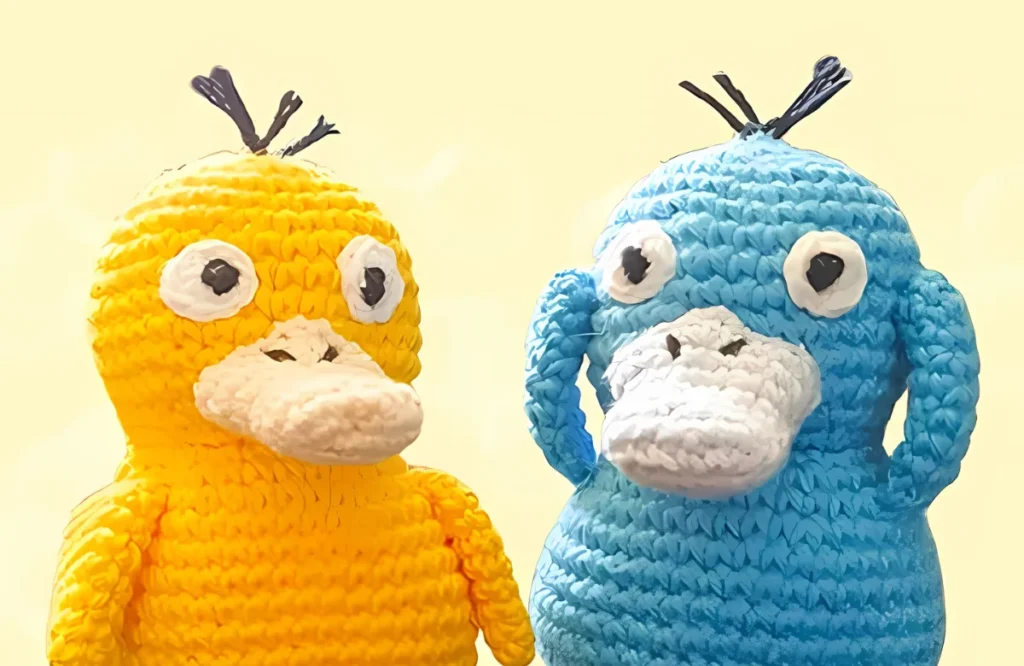
Made and counted by Wren —

Duck-type amigurumi pattern with wings, tail, and beak

Worsted-weight yarn crochets a 5-piece amigurumi duck with a 32-round head and body.

Duck-type amigurumi pattern with wings, tail, and beak
IntermediateLevel
4-6 hoursTime
WorstedYarn
Jump to the pattern

About this pattern

This pattern makes an amigurumi duck-type character in five pieces: a 32-round head and body, 9-round wings, 5-round tail, 8-round beak, and feet built from three toes worked over 2 rounds each before joining. Construction uses magic-ring starts and standard increase rounds throughout, with stitch counts reaching up to 48 stitches at the head and body's widest rounds.

This amigurumi builds a duck-type character from five separate pieces: head and body worked as one continuous piece over 32 rounds, plus wings, tail, beak, and feet. Feet start as three individual toes, each increased from 4 to 6 stitches over 2 rounds, then joined into a single foot. Wings and tail follow the same magic-ring start, expanding through paired increase rounds to 12 and 15 stitches. The 32-round head and body carries the most shaping and determines final proportions.

Skill level: Beginner.

The pattern

Written out round by round

Materials

  • Worsted weight yarn
  • Crochet hook (size to suit your yarn)
  • Polyester fiberfill (for stuffing)
  • Yarn needle (for sewing pieces together)
  • Scissors
  • Stitch marker

Abbreviations

  • ch = chain
  • sl st = slip stitch
  • sc = single crochet
  • hdc = half double crochet
  • inc = increase
  • dec = decrease
  • mr = magic ring
  • flo = front loops only

Head and body

Round 16 sc in MR (6)
Round 2inc x6 (12)
Round 3(sc,inc)x6 (18)
Round 4(sc,inc,sc)x6 (24)
Round 5(3sc,inc)x6 (30)
Round 6(9sc,inc)x3 (33)
Round 7(5sc,inc,5sc)x3 (36)
Rounds 8–13sc around (36)
Round 14(2sc,dec,2sc)x6 (30)
Round 15(3sc,dec)x6 (24)
Round 16In FLO. (3sc,inc)x6 (30)
Round 17(2sc,inc,2sc)x6 (36)
Round 18(5sc,inc)x6 (42)
Round 19(3sc,inc,3sc)x6 (48)
Rounds 20–25sc around (48)
Round 26(3sc,dec,3sc)x6 (42)
Round 27(5sc,dec)x6 (36)
Round 28(2sc,dec,2sc)x6 (30)
Round 29(3sc,dec)x6 (24)
Round 30(sc,dec,sc)x6 (18)
Round 31(sc,dec)x6 (12)
Round 32dec x6 (6)Cut yarn and fasten off.

Wings

Round 14 sc in MR (4)
Round 2(sc,inc)x2 (6)
Round 3(2sc,inc)x2 (8)
Round 4(3sc,inc)x2 (10)
Round 5(4sc,inc)x2 (12)
Rounds 6–8sc around (12)
Round 9(4sc,dec)x2 (10)

Flatten the piece and crochet through both layers to close it. Don’t stuff.

Cut yarn with tail for sewing.

Tail

Round 14 sc in MR (4)
Round 2(sc,inc)x2 (6)
Round 3(sc,inc)x3 (9)
Round 4(2sc,inc)x3 (12)
Round 5(3sc,inc)x3 (15)Cut yarn with tail for sewing.

Beak

The beak is worked around a chain.

Ch 6.

Round 1sc in 2nd chain from hook, 3sc, 3-inc in last stitch, continue on other side 3sc, inc (12)
Round 2inc, 4sc, 2x inc, 4sc, inc (16)
Round 33 sc, dec, 6sc, dec, 3sc (14)
Round 42 sc, dec, 5sc, dec, 3sc (12)
Round 5sc around (12)
Round 6inc, 4sc, 2x inc, 4sc, inc (16)
Round 7(inc,7sc)x2 (18)
Round 85 sc, hdc-inc, 5 sc, slst. Pull yarn through and leave tail for sewing. The last round is only a half round.Stuff lightly.

You can use the tail from the beginning chain to sow the top and bottom lightly together to make sure psyduck doesn’t end up with a round beak.

Connect you pieces in a pose of your wish and enjoy your psyduck!

Designer: yarn_and_beyond

Feet

Step by step: Toes (make 3, don’t cut yarn on last one); the individual toes are made first and later connected to form the rest of the foot.

Round 14 sc in MR (4)
Round 2(sc,inc)x2 (6)

Step by step: The 3 pieces will now be referred to as A, B and C; A is the piece with yarn still attached.

Round 33 sc in A, 3 sc in B, 6 sc in C, 3 sc in B, 3 sc in A (18)

The pieces are now connected. Continue around in the round as usual.

Round 4(sc,dec,3sc,dec,sc)x2 (14)
Round 53sc,dec,5sc,dec,2sc (12)
Round 62sc,dec,4sc,dec,2sc (10)
Round 7dec x5 (5)Fasten off, leaving a yarn tail for sewing.

Tester's notes

32 rounds shape the head and body as one continuous piece, so keep a stitch marker on the first stitch of each round to avoid losing the spiral over that many rounds.

3 toes are worked before joining, and yarn is left attached on only the last one — keep that working loop separated from the other two toes so it doesn't tangle during assembly.

12 stitches is the target after round 2 on the head/body and after the early rounds on several other pieces; recount at each of these checkpoints before continuing.

8 rounds shape the beak relative to its visual prominence on the finished face, so keep tension even enough that stuffing doesn't show through the fabric.

5-round pieces (tail and feet) leave little room to maneuver a stuffing tool after closing, so add stuffing gradually as each piece is worked rather than all at once at the end.

At a glance

Rounds49
Parts5
LevelIntermediate
Time4-6 hours
YarnWorsted

Gauge check

After round 2 of the head and body (12 stitches), check that fabric shows no visible gaps between stitches when gently stretched, since stuffing needs to stay hidden without a swatch to reference.

If stitches gap open at that checkpoint, drop to a smaller hook; if the round curls tightly and won't lie flat, size up.

Stitch-count checkpoints

  • Head and body · Round 7: 36 sts
  • Head and body · Round 19: 48 sts
  • Head and body · Round 31: 12 sts
  • Head and body · Round 32: 6 sts
  • Wings · Round 2: 6 sts
  • Wings · Round 4: 10 sts

If something looks wrong

The foot looks lopsided once the three toes are joined.
Toes are worked separately and identified as A, B, and C before joining; lay all three side by side in the same orientation before single crocheting them together so none ends up twisted.
The head and body cups instead of
Round 3's (sc, inc) x6 sequence needs increases spaced exactly six stitches apart; place a marker at each increase point so a missed stitch doesn't throw off the spiral.
The wings or tail flare outward instead
Both pieces rely on evenly paired increases each round; recount stitches after every round rather than at the end so a skipped increase gets caught immediately.
The stitch count comes up short right
A missed increase earlier in the round is the usual cause; count stitches immediately after each increase round instead of waiting until the next round is underway.

Yarn substitutions

Acrylic, worsted weightMatches the density the round counts assume; holds its shape through the 32-round head and body without extra reinforcement.
Cotton, worsted weightProduces stiffer, more defined stitches that hide stuffing better through the 8-round beak and 5-round tail, but has less give, so a slightly larger hook may be needed to match gauge.
Wool-acrylic blend, DK weightShrinks the finished toy since the same round counts cover less area; drop to a smaller hook and reduce stuffing slightly to match the lighter fabric.
FAQs

Questions

Why is yarn left attached on only one of the three toes?

That toe (piece A) becomes the base for joining all three toes into the finished foot without cutting yarn. It saves an end to weave in and keeps the join continuous.

How many pieces need to be assembled at the end?

Five main sections: head and body, wings, tail, beak, and feet. The feet themselves are assembled first from three toes before being attached as a single unit.

One at a time —

Get the next pattern

Tested round by round before it is sent. No spam.