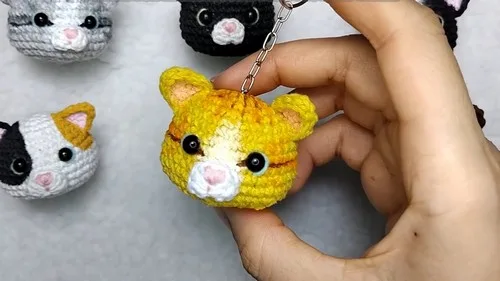
Made and counted by Wren —

Crochet cat keychain pattern with painted face details

2 mm hook, fingering-weight cotton-polyester yarn makes this crochet cat keychain with painted facial details.

Crochet cat keychain pattern with painted face details
BeginnerLevel
2-3 hoursTime
2 mmHook
FingeringYarn
Jump to the pattern

About this pattern

This pattern builds a small amigurumi cat keychain: a 16-round head, three-round ears, and a one-piece snout closed with a magic ring, worked with a 2 mm hook in 369 Tex cotton-polyester yarn. Assembly uses a hexagon base to orient the face, with ears sewn between rounds 4-7, snout between rounds 10-12, and 6 mm eyes glued at round 9. Facial color comes from fabric paint, not yarn changes.

This crochet cat keychain starts as a single amigurumi head worked in continuous rounds, 16 in total, with a separate three-round ear piece and a flat snout built from one magic ring and closed with a pulled-tight tail. The head's base rounds form a hexagon, and that shape sets the center point used to place the face. Ears attach between rounds 4 and 7, the snout between rounds 10 and 12, and 6 mm eyes glue on at round 9. Fabric paint and embroidery finish the face, so no color-change rounds appear anywhere in the body.
The pattern

Written out round by round

Materials

  • Verao yarn (369 Tex, 50% Cotton / 50% Polyester)
  • 2 mm crochet hook
  • Fabric paint and brush
  • 6 mm eyes (half pearls or safety eyes)
  • Silicone glue
  • Acrylic yarn for eye and nose (200 Tex)
  • Stitch marker, scissors, needle
  • Stuffing
  • Keychain ring

Abbreviations

  • ST = Stitch
  • R = Round
  • CH = Chain
  • SC = Single Crochet
  • HDC = Half Double Crochet
  • DC = Double Crochet
  • INC = Increase
  • DEC = Decrease
  • BLO = Back Loop Only
  • FLO = Front Loop Only
  • (...) = Repeat instructions in parentheses
  • [...] = Total stitch count at end of round

Head

Make a magic ring

Round 16 SC in magic ring
Round 26 INC
Round 3(1 SC, 1 INC) x 6
Round 41 SC, 1 INC, (2 SC, 1 INC) x 5, 1 SC
Round 5(3 SC, 1 INC) x 6
Round 630 SC
Round 72 SC, 1 INC, (4 SC, 1 INC) x 5, 2 SC
Round 8R10: 36 SC
Round 11(5 SC, 1 INC) x 6
Round 123 SC, 1 INC, (6 SC, 1 INC) x 5, 3 SC
Round 13(6 SC, 1 DEC) x 6
Round 14(5 SC, 1 DEC) x 6
Round 15(2 SC, 1 DEC) x 9
Round 16(1 SC, 1 DEC) x 9 Begin stuffing
Round 17(1 SC, 1 DEC) x 6
Round 186 DEC Sew through front loops to close Hide yarn inside and cut

Ears

Make a magic ring

Round 16 SC in magic ring
Round 2(1 SC, 1 INC3) x 3 (INC3 = 3 SC in one ST) Cut yarn tail from ring
Round 37 SL ST Pinch ends to shape triangle Make 2 ears

Snout

Magic ring, CH 2, 6 DC, CH 2, SL ST into ring Pull yarn to close tightly and tie a knot Leave a long tail for sewing Use pink acrylic yarn to embroider the nose

Assembly

Step 1Identify hexagon shape at the base
Step 2Choose one point as center of face
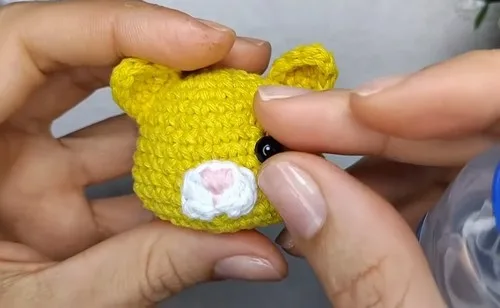
Step 3Sew snout between rounds 10 and 12
Step 4Sew ears between rounds 4 and 7
Step 5Insert yarn in middle of ST before sewing
Step 6Sew the unstretched side of ear (not slip-stitched part)
Step 7Glue eyes on round 9 using silicone glue
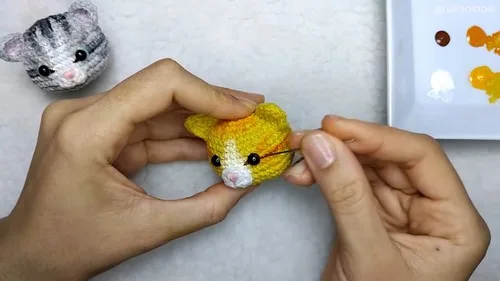
Step 8Use fabric paint to add facial patterns
Step 9For yellow cat: blend white, yellow, orange, and brown
Step 10Paint slowly, expanding gradually for precision
Step 11Add pink paint inside ears
Step 12Embroider green details in eyes with yarn
Step 13Attach keychain ring to complete the project

Tester's notes

2 mm is the hook size that keeps 369 Tex cotton-polyester yarn tight enough to hide stuffing; size down if stitches gap.

Round 1 is where the stitch marker goes; move it every round through all 16 rounds, since continuous rounds have no join to mark the start.

No rounds use color changes; facial color comes from fabric paint and pink acrylic embroidery applied after assembly, not from yarn.

Round 9 is where 6 mm eyes attach with silicone glue, not pushed through as safety-eye posts, so let the glue set before handling the head further.

Round 16 closes the head after firm stuffing; keep the snout's pulled-tight tail snug so it holds shape once sewn between rounds 10 and 12.

Work in progress

Crochet cat keychain pattern with painted face details — photo 2
Crochet cat keychain pattern with painted face details — photo 3

At a glance

Rounds19
Parts3
LevelBeginner
Time2-3 hours
Hook2 mm
YarnFingering

Gauge check

After round 2 (6 INC), check that each increased stitch sits close enough to hide stuffing without stretching the fabric thin.

If gaps show at that round, drop to a smaller hook or tighten tension before continuing through the rest of the head's 16 rounds.

If something looks wrong

The head doesn't sit as a clean hexagon at the base.
Increase placement drifted somewhere in rounds 1 through 3; recount each of those rounds before moving on, since the hexagon from round 3 sets the orientation for the whole face.
The ears flare flat instead of forming a triangle.
The 7 slip stitches in round 3 were not pinched while shaping; pinch the ear ends together right after that round so it sets as a point, then sew the unstretched side to the head.
The snout won't close tightly at the center.
The magic ring tail wasn't pulled hard enough after the final slip stitch into the ring; pull the tail firmly before knotting so the 6 DC sit snug around the closed ring.
Fabric paint bleeds past the intended lines.
Too much paint was loaded on the brush at once; work slowly and expand the design gradually in thin layers instead of one heavy pass.

Yarn substitutions

100% cotton, sport weight (close to the 369 Tex original)Keeps the same firm stitch definition for fabric paint but may need a 2.25 mm hook instead of 2 mm to match gauge, since cotton has less give than the cotton-polyester blend.
100% acrylic, light fingering weightDrapes more and costs less, but the finished head may run slightly larger at the same hook size since acrylic rounds out further; keep the 2 mm hook and check round 2 (6 INC) for gaps before stuffing.
Cotton-linen blend, DK weightProduces a stiffer fabric that holds the hexagon base shape well but is harder on hands at a 2 mm hook; sizing up to a 2.5 mm hook eases tension without changing the stitch counts.
FAQs

Questions

Why does the pattern use fabric paint instead of crocheted color changes for the face?

The head, ears, and snout are worked in a single yarn color with no color-change rounds anywhere across the 16 rounds. Facial markings and the yellow-cat blend of white, yellow, orange, and brown go on afterward with fabric paint, which keeps the amigurumi shaping simple.

Can safety eyes replace the half pearl eyes without changing the pattern?

Yes; both 6 mm half pearls and 6 mm safety eyes are listed as options for the same round 9 placement. Half pearls need silicone glue after stuffing, while safety eyes need insertion before the head closes, so decide before reaching round 16.

What does 'hexagon shape at the base' mean when starting assembly?

It refers to the shape formed by the increase rounds at the start of the head, used to orient which point becomes the center of the face. Identify that hexagon first, then measure ear and snout placement, rounds 4-7 and 10-12, from the chosen center point.

One at a time —

Get the next pattern

Tested round by round before it is sent. No spam.