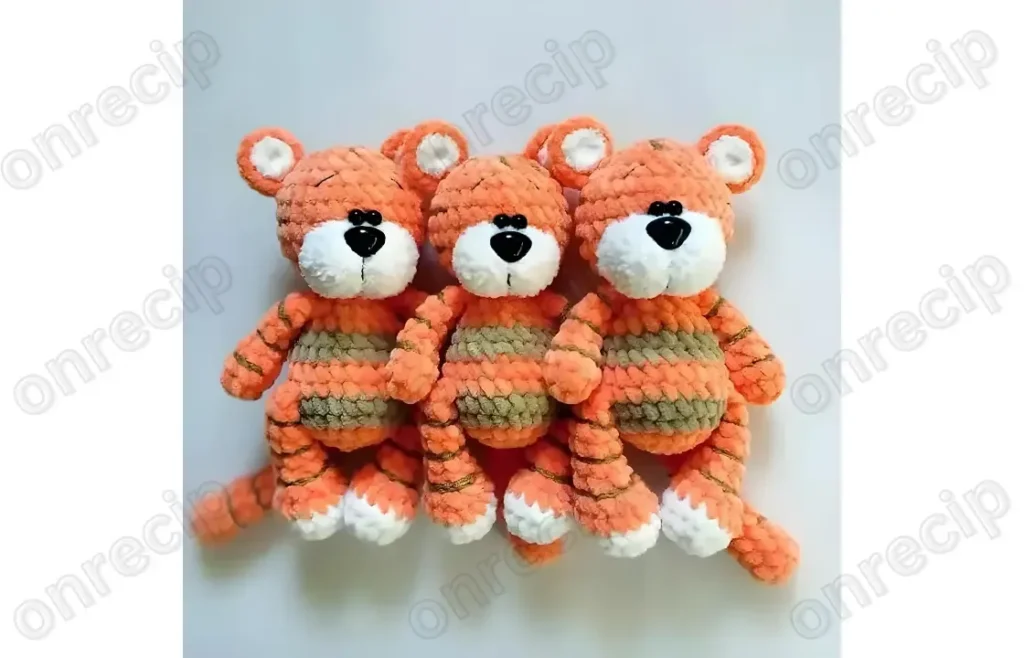
Made and counted by Wren —

Amigurumi tiger cub pattern with plush body and tapered legs

4-4.5mm hook, worsted plush yarn: crochet a little tiger cub with color-blocked body and tapered legs.

Amigurumi tiger cub pattern with plush body and tapered legs
IntermediateLevel
4-6 hoursTime
4.5 mmHook
WorstedYarn
Jump to the pattern

About this pattern

A plush amigurumi tiger cub crocheted in two parts: a continuously worked body that changes color from orange to brown and back while shaping from 24 sc to 9 sc, then back up to 18 sc, and legs built from a 4-chain base tapering from 14 sc to 8 sc with a folded toe at rows 7-11. Hook range is 4-4.5mm; stuffing and a needle finish the pieces.

The pattern

Written out round by round

Materials

  • Plush yarn Himalaya Dolphin Baby: orange, brown, white
  • Fluffy yarn Alize Softy: white (for muzzle and ears)
  • Black smooth thread
  • Hook 4-4.5 mm
  • Eyes for toys
  • Stuffing for toys
  • Needle for sewing parts
  • Scissors

Abbreviations

  • ch = chain
  • sc = single crochet
  • inc = increase
  • dec = decrease

Main Pattern

Rounds 6–724 sc Change the yarn (brown) 24 sc (2 sc dec) x 6 (18)Change the yarn (orange)18 sc (1 sc dec) x 6 (12)(2 sc dec) x 3 (9)9 inc (18)(2 sc inc) x 6 (24)(3 sc inc) x 6 (30)
Rounds 16–1930 sc (3 sc dec) x 6 (24)(2 sc dec) x 6 (18)(1 sc dec) x 6 (12)6 dec. Stuff as you crochet.

Legs

4 ch, from the second stitch, sc, 3 sc in one stitch, 2 sc (8) inc, sc, 3 inc, sc, 2 inc (14)

14 sc Change the yarn (orange)

14 sc 3 sc, 4 dec, 3 sc (10)

3 sc, 2 dec, 3 sc (8)

Rounds 7–118 sc Fold and crochet 4 sc (if when folded the toe points to the side, crochet 3 additional sc).The legs can be crocheted into the head-body part. Then row 6 looks like this: 4 sc with leg, 8 sc, 4 sc with leg, 8 sc If it’s easier to sew, then sew in the 6th row.

Ready to Learn More? Open the next page for Further Guidance!

Pages: 1 2

Tester's notes

4-4.5mm hook range: test both ends on the first 24 sc round and keep whichever gives a dense fabric, since plush yarn forgives a looser gauge that will still gap at the stuffing stage.

6-repeat and 3-repeat decrease rounds (x6 then x3) land the body at 18 sc then 9 sc; count after each repeat set instead of after the full round to catch a missed decrease early.

Stuffing needs to go in before the stitch count closes down to 9 sc, since that opening is too narrow to pack firmly afterward.

Legs taper from 14 sc to 8 sc before the fold at rows 7-11; keep a stitch marker on the first stitch of that fold round so the toe lines up straight, not skewed.

At a glance

Rounds3
Parts2
LevelIntermediate
Time4-6 hours
Hook4.5 mm
YarnWorsted

Gauge check

After the round that brings the main body down to 18 sc, count stitches directly rather than trusting row height, since plush yarn hides stitch definition.

If the fabric looks loose enough to show stuffing through the gaps, drop to the 4mm end of the hook range; if it curls or cups instead, move up toward 4.5mm.

Stitch-count checkpoints

  • Main Pattern · Rounds 6–7: 18 sts
  • Main Pattern · Rounds 16–19: 24 sts

If something looks wrong

Stitch count comes up short after the (2 sc dec) x6 round.
A decrease repeat was likely skipped or the round started one stitch off; recount against the 18 sc target and redo the decrease round rather than correcting further along.
The leg toe points to the side instead of straight after folding at rows 7-11.
The fold was worked without the extra stitch the pattern calls for; add 1 additional sc (3 instead of the standard count) as noted at that row.
The body cups or puckers right at the 9 sc decrease point instead of lying flat.
Decrease stitches were pulled too tight, over-cinching the fabric; loosen tension on those stitches or size up toward the 4.5mm end of the hook range.

Yarn substitutions

Acrylic chenille or velvet yarn, worsted weightClosest match to the plush texture called for; keeps the piece at roughly the same finished size and takes the same 4-4.5mm hook with no stuffing adjustment.
Cotton-acrylic blend, DK weightLess plush and more stitch definition, so color-change rounds show more clearly; drop to the 4mm end of the hook range and use slightly less stuffing to avoid a stiff, over-filled look.
Wool-blend, bulky weightFinished body and legs run larger than the original counts suggest; use the top of the hook range or slightly larger, and reduce stuffing volume so the fabric doesn't stretch thin.
FAQs

Questions

What if the leg toe comes out pointing sideways after the fold?

The pattern accounts for this directly: at rows 7-11, crochet 3 additional sc instead of the standard count when the fold causes the toe to point to the side. Check toe direction before closing the fold permanently.

Does it matter which end of the 4-4.5mm hook range is used?

Yes — test both ends on the first 24 sc round before committing. The denser result at 4mm hides stuffing better; 4.5mm works if the yarn is already running thick and tight at 4mm.

One at a time —

Get the next pattern

Tested round by round before it is sent. No spam.