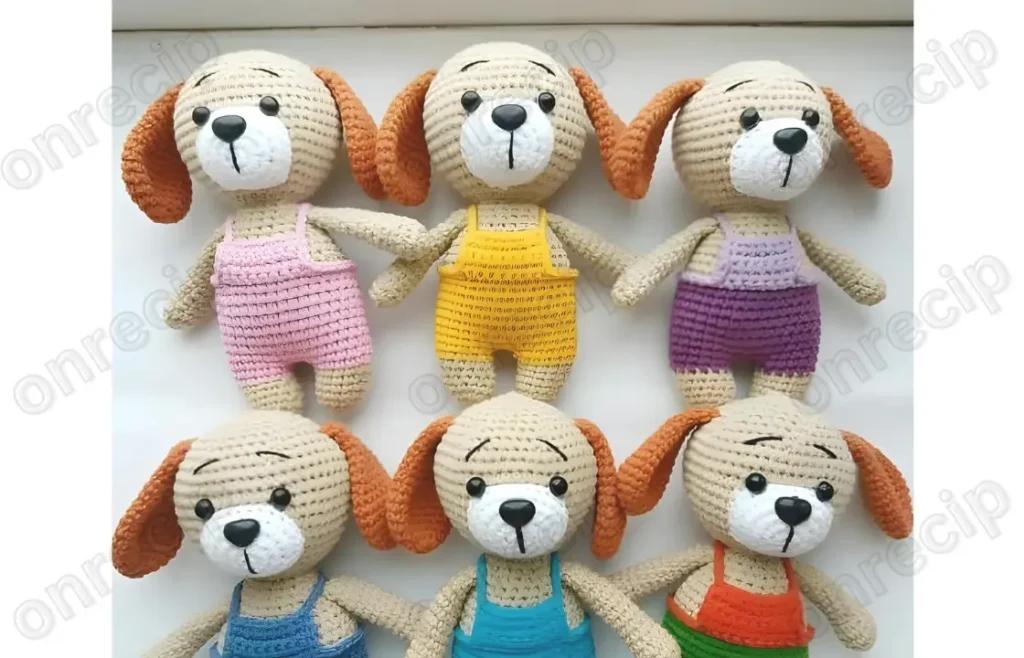
Made and counted by Wren —

Amigurumi puppy dog pattern with safety eyes and nose

2.0mm hook, DK cotton-acrylic yarn: crochet an amigurumi puppy dog with safety eyes and nose.

Amigurumi puppy dog pattern with safety eyes and nose
IntermediateLevel
4-6 hoursTime
2.0 mmHook
DKYarn
Jump to the pattern

About this pattern

This pattern makes a small amigurumi puppy dog using a 2.0 mm hook and cotton-acrylic yarn (50 g/160 m). Construction runs in continuous rounds, opening with a 12-stitch increase round and a 15-stitch round, continuing through R26 with legs made twice. Safety eyes, a safety nose, and fiberfill finish the piece; expect a compact toy sized to the tight gauge of the small hook.

This amigurumi puppy dog builds in continuous spiral rounds, starting with a standard 6-increase round that brings the first round to 12 stitches, then a second increase round to 15. Legs are made twice and worked separately before joining to the body, and rounds run through R26 with a stretch from R10 to R17 forming the main body shape. Safety eyes and a safety nose lock in the face; stuffing goes in as rounds close. The piece uses a 2.0 mm hook and a cotton-acrylic blend yarn (50 g/160 m), giving a firm, small-scale finished toy.

The pattern

Written out round by round

Materials

  • YarnArt Jeans yarn (55% cotton, 45% acrylic, 50 g/160 m)
  • 2.0 mm crochet hook
  • Black safety eyes
  • Plastic safety nose
  • Yarn needle and scissors
  • Fiberfill

Abbreviations

  • ch = chain
  • sc = single crochet
  • inc = increase
  • dec = decrease

R 2

Round 1(inc) repeat 6 times [12](12)

R 3

Round 1(3 sc, inc) repeat 3 times [15](15)

R 5

Round 1dec, 6 sc, inc, 6 sc [15](15)

R 7

Round 1dec, 6 sc, inc, 6 sc [15] Change to blue yarn:
Round 815 sc Fasten off. Crochet the second leg, do not fasten off. Make 3 ch and join with the first leg.Continue crocheting the body in the round:

R 19

Round 1(4 sc, dec) repeat 6 times [30](30)

R 22

Round 1(3 sc, dec) repeat 6 times [24](24)

R 25

Round 1(2 sc, dec) repeat 6 times [18](18)

Body

Round 915 sc on the first leg, 3 sc in 3 ch, 15 sc on the second leg, 3 sc in 3 ch (opposite side) [36](36)

R 26

Round 27(1 sc, dec) repeat 6 times [12] Continue crocheting the head. Ready to Learn More? Open the next page for Further Guidance!

Pages: 1 2

Legs (make 2)

With beige yarn:

R 1

6 sc in magic ring [6]

R 10-17

36 sc (8 rows) Change to beige yarn:

Tester's notes

2.0 mm hook: hold tension tight through the increase rounds (R2, R3) so the 12- and 15-stitch counts stay accurate and fiberfill does not show through later.

50 g/160 m yarn: one ball covers the toy at this scale; keep the label on hand to match dye lot if a second ball is needed for a contrast color.

R2 and R3: mark the start of each round with a stitch marker, since the piece works in continuous spirals with no join between rounds.

R7 runs 2 rounds: recount stitches at the end of both before moving on to R19, so any drift shows up early rather than at R25 or R26.

R10-17 and Legs (make 2): stuff each leg firmly before closing so the shaping built into R10-17 holds once the leg is attached to the body.

At a glance

Rounds10
Parts12
LevelIntermediate
Time4-6 hours
Hook2.0 mm
YarnDK

Gauge check

After R2 (12 stitches) and R3 (15 stitches), check that the single crochet fabric is tight enough to hide fiberfill with no visible gaps between stitches.

If gaps are visible at this tension, work more tightly or move down a hook size until the stitches close up before continuing to R5.

Stitch-count checkpoints

  • R 2 · Round 1: 12 sts
  • R 3 · Round 1: 15 sts
  • R 5 · Round 1: 15 sts
  • R 19 · Round 1: 30 sts
  • R 22 · Round 1: 24 sts
  • R 25 · Round 1: 18 sts

If something looks wrong

The head or body cups instead of lying flat after R2 and R3.
Increases were skipped or doubled in the 6-repeat pattern. Recount to confirm exactly 12 stitches after R2 and 15 after R3 before continuing.
Stitch count drifts by R19 or R22 even though early rounds matched.
A stitch was likely picked up through the wrong loop somewhere in the plain rounds between R7 and R19. Place a marker at the round start and count every few rounds instead of waiting until R25 or R26.
The two legs come out different sizes.
Tension loosened partway through the second leg of the Legs (make 2) section. Work both legs back to back and check stitch count against the first leg every few rounds.
Fiberfill shows through the stitches once the safety eyes and nose are set.
The 2.0 mm hook was likely swapped for something larger, or tension loosened. Return to a 2.0 mm hook and stuff in small pieces rather than one large clump.

Yarn substitutions

Cotton DK, 100% cottonFirmer stitch definition than the cotton-acrylic blend, with less give when stuffing tight. Keep the 2.0 mm hook; expect a slightly heavier finished toy.
Acrylic sport weight, 100% acrylicLighter than the 55/45 cotton-acrylic blend. A 2.5 mm hook may be needed to match the same tight gauge and hide stuffing.
Cotton-acrylic blend, sport weight (50 g/130-150 m)Close match to the pattern yarn's fiber content, but fewer meters per ball means more balls are needed to reach the same 50 g/160 m coverage.
FAQs

Questions

Does this pattern use a join at the end of each round?

No join is specified. Rounds such as R2, R3, and R5 read as continuous spiral rounds, so mark the start of each round to track progress through R7 to R26.

How much yarn does the puppy dog need?

The materials list one 50 g/160 m ball of cotton-acrylic yarn. A single-color version needs no more than that one ball, though a second ball covers contrast panels if a second color is added.

What size hook keeps the stitches tight enough for the safety eyes to stay in?

A 2.0 mm hook is specified for the whole toy. Match that hook size through R2 and R3 so the fabric stays dense enough that fiberfill does not show and the safety eyes and nose sit securely.

One at a time —

Get the next pattern

Tested round by round before it is sent. No spam.