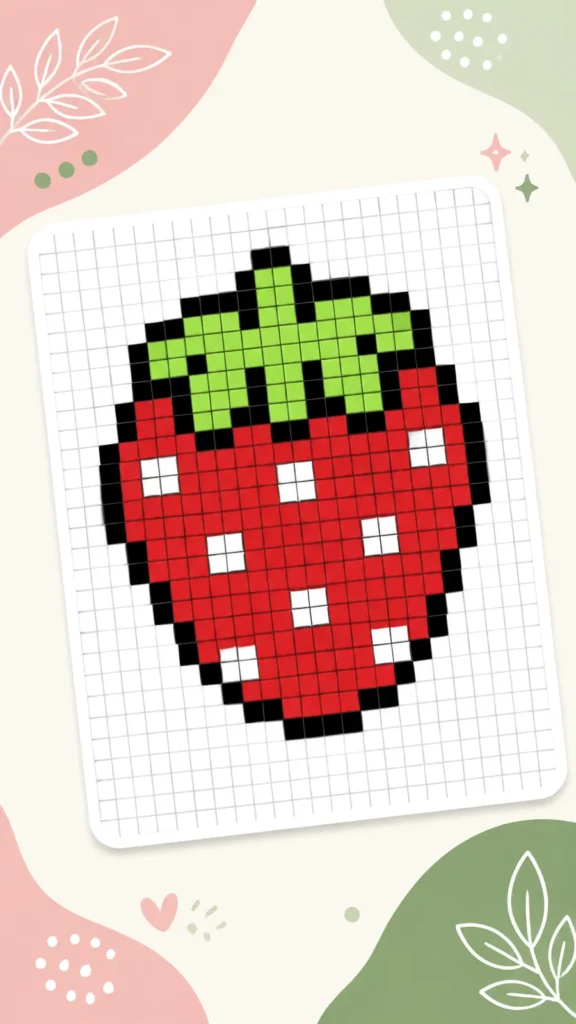
Made and counted by Wren —

30×30 pixel grid crochet panel for blankets and pillows

4.0 mm hook, worsted-weight yarn: 10x10in pixel panel for blankets, pillows, or wall art.

30x30 pixel grid crochet panel for blankets and pillows
Confident Beginner to IntermediateLevel
4-6 hoursTime
4.0 mmHook
WorstedYarn
Jump to the pattern

About this pattern

A 30x30 stitch pixel chart worked flat in single crochet rows, using tapestry crochet to carry dark, red, and white yarn into a strawberry motif. Each row holds 30 stitches, worked bottom to top with a 4.0 mm hook. Finished panel measures about 10 x 10 inches before the optional two-round border. The piece works as wall art, a blanket square, or a pillow cover front.

This project builds a 30x30 stitch pixel chart into a flat crochet panel, worked row by row from the bottom up in dense single crochet. Tapestry crochet carries dark, red, and white strands together to form a strawberry motif with a leafy top and dark outline. Every row holds exactly 30 stitches, and that count is what keeps the chart aligned from Row 1 through the final color row. Finished size runs about 10 x 10 inches (25 x 25 cm) before any border rounds go on.

The pattern

Written out round by round

Materials

Yarn

  • Medium weight (#4) acrylic or cotton yarn, approximately 350 yards (320 meters) total

Red yarn

  • approximately 180 yards (165 meters)

Green yarn

  • approximately 60 yards (55 meters)

Dark outline yarn

  • Black or dark outline yarn: approximately 70 yards (64 meters)

White accent yarn

  • approximately 40 yards (37 meters)

Tools

  • 4.0 mm US G-6 crochet hook
  • Yarn needle
  • Scissors
  • Stitch markers

Abbreviations

  • ch = chain
  • sc = single crochet
  • sl st = slip stitch
  • st = stitch
  • RS = right side
  • WS = wrong side
  • rep = repeat
  • Special Technique = To change colors, complete the final yarn over of the previous stitch with the new color. Carry unused yarn inside the row and crochet over it when possible.

Starting Instructions

With dark outline yarn, chain 31.

Row 1Sc in second ch from hook and across. Turn. (30 sc)Each row below contains 30 stitches. Work from the bottom row upward. Use the color chart concept below:

Color Key

D = dark outline R = red G = green W = white

Grid Row Instructions

Rows 1–5Work 30 sc in D.
Rows 6–8Work 5 D, 20 R, 5 D. Turn after each row. (30 sts)
Rows 9–12Work 3 D, 24 R, 3 D. Add W stitches according to the strawberry seed placement by replacing selected red stitches with white.
Rows 13–18Work 2 D, 26 R, 2 D. Add symmetrical W seed accents across the center area.
Rows 19–21Work 3 D, 24 R, 3 D. Begin shaping the upper fruit edge.
Rows 22–24Work 5 D, 20 R, 5 D with green stitches beginning in the upper center area.
Rows 25–27Create the leafy top using G stitches surrounded by D outline stitches.
Rows 28–30Finish with D outline stitches across the top edge.

Because this is a grid-style project, follow the visual placement carefully by counting each square. Each row must always total 30 stitches.

Border Instructions

After completing the panel, join red yarn in any corner.

Round 1Ch 1, sc evenly around all four sides, placing 3 sc in each corner. Join with sl st to first sc.
Round 2Ch 1, sc around the entire border. Place 3 sc in each corner stitch. Join with sl st and fasten off.

Assembly

Step 1Weave in all loose ends using a yarn needle.
Step 2Block the panel gently to create straight edges.
Step 3Allow the piece to dry completely before assembling into a larger project.
Step 4Blocking helps relax the stitches and improves the square shape of the finished crochet panel. Use gentle steam or damp blocking methods suitable for your yarn fiber.
Step 5For long-lasting color and softness, wash handmade crochet pieces according to the yarn label instructions. Store finished projects away from moisture and direct sunlight.

Tester's notes

70 yards of dark outline yarn covers every black detail from Row 9 through the border rounds; keep it on a separate strand or bobbin so it does not tangle with the red and white carries.

4.0 mm hook stays fixed for the entire panel; swapping hook sizes mid-project changes the stitch count per row and throws off the 30-stitch alignment the chart depends on.

Place a stitch marker at the start of Row 1 and again every fifth row; a miscount on one row otherwise carries upward through the seed placement worked in Rows 9-18.

Carried strands behind the work need to stay loose, not slack; tight floats are the main reason a 30-stitch row comes in narrower than the row below it.

Gauge: approximately 18 single crochet stitches x 20 rows = 4 inches (10 cm). Check this before starting the full panel, since the 30-stitch rows and the 10 x 10 inch finished size depend on it.

At a glance

Rounds11
Parts4
LevelConfident Beginner to Intermediate
Time4-6 hours
Hook4.0 mm
YarnWorsted

Gauge check

After Rows 1-5, lay the swatch flat and measure the width of the 30-stitch row; it should land close to 10 inches (25 cm) once blocked, matching the finished panel width given for this chart.

If the row runs noticeably narrower or wider than that, go up or down half a hook size before starting the Row 6 color change, since the whole 30x30 grid depends on that first row width holding steady.

If something looks wrong

The panel cups or curls instead of
Carried yarn behind the fabric was pulled too tight across the 20-24 stitch color sections; redo the carry with slack equal to the stitch width and block the piece face down to flatten it.
The strawberry motif looks skewed or
A stitch was added or dropped somewhere in an earlier row, most likely during the Rows 9-12 or 13-18 seed placement; count the current row against its stated 30 stitches and unravel back to the first row that does not match.
Rows near the top of the panel measure
Tension tightened gradually on the carried floats as more color changes were introduced; loosen the hold on the non-working yarn and recheck row width every few rows against the earlier rows.
The border rounds pucker at the corners
Fewer or more than 3 sc were worked into a corner stitch during Round 1 or Round 2; pull back to the corner in question and rework it with exactly 3 sc before continuing around.

Yarn substitutions

Cotton, worsted weightProduces a stiffer, flatter fabric that holds the pixel edges sharply, which suits a pillow cover front; the 4.0 mm hook and 30-stitch row count stay the same.
Acrylic, worsted weightKeeps the same 4.0 mm hook and stitch count but drapes more than cotton, which suits adding this panel into a larger blanket.
Chunky or bulky weight, single-plyReaches the finished size faster with fewer total stitches needed if the chart is rescaled, but requires a larger hook than 4.0 mm and changes the 10 x 10 inch finished measurement given here.
FAQs

Questions

Can this panel be joined into a larger blanket?

Yes, the piece is worked flat in rows with a square shape, so it joins to other panels along any side. Keep the 30-stitch row count consistent if making multiple panels so edges line up.

How much yarn does the whole project use?

The materials list calls for about 180, 60, 70, and 40 yards across the four colors, which totals roughly 350 yards. That covers the 30x30 panel plus the two border rounds.

Does this work as a pillow cover on its own?

The panel is a single flat piece, so it needs a plain backing square of the same size sewn or crocheted on to close it into a cover. The finished 10 x 10 inch size sets the pillow form size to match.

One at a time —

Get the next pattern

Tested round by round before it is sent. No spam.