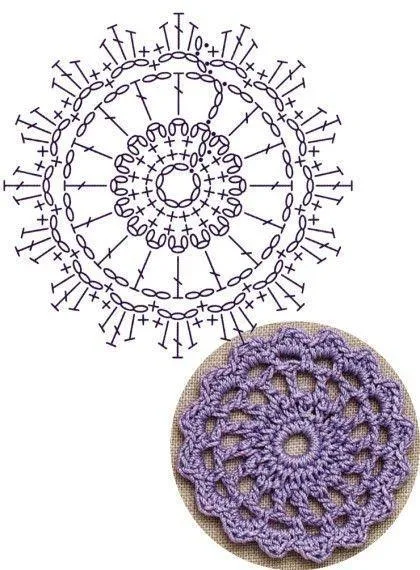
Made and counted by Wren —

Circular crochet: mastering even rounds and increases

4 mm hook, worsted cotton yarn: build flat doilies, mandalas, coasters, and rugs in even single/half-double crochet rounds.

Circular crochet: mastering even rounds and increases
IntermediateLevel
2-4 hoursTime
4 mmHook
WorstedYarn
Jump to the pattern

About this pattern

A circular crochet motif worked from a magic ring or a chain ring, using worsted weight cotton and a 4 mm hook. Round counts run from 6 stitches to 48 across the Common Increase Formula and Main Pattern sequences, with a color change at round 4. The finished piece works as a doily, mandala, coaster, or rug center depending on scale.

This pattern builds a flat circular motif starting from a magic ring, worked in worsted weight cotton on a 4 mm hook. Round 1 sets 6 single crochets or 11 half-double crochets plus a turning chain-2, then each following round adds a fixed number of stitches — 6 per round for single crochet, 12 per round for half-double crochet — to keep the fabric flat instead of curling or waving. Three colors carry the piece from doily to mandala to coaster, with a color change built into round 4 of the Main Pattern.

The pattern

Written out round by round

Materials

  • Worsted weight cotton yarn (3 colors)
  • Crochet hook 4 mm
  • Scissors
  • Tapestry needle

Abbreviations

  • sc = single crochet
  • hdc = half double crochet

Common Increase Formula

Each round of a circular pattern must grow evenly. The secret? Strategic increases.

Round 16 single crochets (SC)(6)
Round 22 SC in each stitch (12 stitches)(12)
Round 31 SC, 2 SC in next stitch (18 stitches)(18)
Round 42 SC, 2 SC in next stitch (24 stitches)(24)

Continue increasing evenly each round. Each round increases by 6 stitches if you're using single crochets, 12 for half-double crochets, and so on. The key is balance — too many increases cause waves, too few cause curling.

Main Pattern

Round 1Make a magic ring. Chain 2 (counts as first half double crochet). Work 11 half double crochets (HDC) into the ring. Slip stitch to join. (12 stitches)Step by step: wrap the yarn around your fingers to form a loop; insert your hook into the loop; yarn over and pull through to form a chain; crochet the required number of stitches into the loop; pull the tail to close the circle snugly.(12)
Round 2Chain 2, 2 HDC in each stitch around. Join. (24)
Round 3Chain 2, 1 HDC in first stitch, 2 HDC in next . Repeat around. Join. (36)
Round 4Change color. Chain 2, 1 HDC in next 2 stitches, 2 HDC in next . Repeat. Join. (48)
Round 5Optional — add decorative edge with single crochets or picots.

1.Doilies and Mandalas

These are the artistic hearts of circular crochet. Made with fine thread and intricate stitchwork, doilies often serve decorative purposes, while mandalas combine vivid colors for wall art or cushions.

Pro Tip: Use cotton yarn for crisp stitches and excellent definition.

2.Circular Rugs

Made with bulky yarn or even fabric strips, circular rugs bring warmth and texture to any room. Experiment with color gradients and stitch combinations (like puff or bobble stitches) for visual depth.

3.Coasters and Placemats

Quick to make and functional, coasters are perfect for beginners. You can play with color blocking , or add picot borders for an elegant touch.

4.Circular Granny Squares

Though “square” in name, many granny motifs start as circles. After a few rounds, corners are formed with chain spaces — a creative twist that bridges round and square shapes.

5.Wearables

Circular motifs can be joined to form shawls, capes, or ponchos . When crafted with fine yarn, these garments drape beautifully and carry a sophisticated handmade charm.

1. Bohemian Mandala Wall Hanging

Combine bright cotton yarns with lacy stitches to create a vibrant art piece for your wall. Finish with tassels or fringe for that boho touch.

2. Minimalist Monochrome Rug

Use thick, natural yarn (like jute or t-shirt yarn) and stick to shades of beige, gray, or cream. The result? A chic, eco-friendly décor item.

3. Festive Table Centerpiece

Alternate red, green, and gold yarns to craft a circular table mat that captures the spirit of the holidays .

4. Crochet Dream Catcher

Work a delicate circular mandala, stretch it inside a metal hoop, and finish with lace ribbons. It’s modern crochet meets rustic elegance.

5. Retro Coaster Set

Play with vibrant color combinations — turquoise, mustard, coral — and crochet mini mandalas for your coffee table.

How to Use Circular Patterns Creatively

Circular crochet isn't limited to single motifs — it's the foundation of modular art. You can: join multiple circles for a blanket or throw; combine large and small circles for bags or hats; use lace circles as appliqués on clothing; layer them for 3D wall décor.

Tester's notes

4 mm hook holds worsted cotton snugly enough to keep single and half-double crochet stitches even without splitting the plies.

Place a stitch marker in the first stitch of each round; the join point shifts by 6 or 12 stitches every round and is easy to lose without one.

Color change lands at round 4 in the Main Pattern — cut the working yarn, leave a 6-inch tail, and join the new color at the first stitch to avoid a knot near the center.

Pull the magic ring tail firm before starting round 2; a loose center hole still shows after blocking, especially if the chain-ring start is used instead.

At a glance

Rounds9
Parts13
LevelIntermediate
Time2-4 hours
Hook4 mm
YarnWorsted

Gauge check

After round 3 (18 stitches in the Common Increase Formula, or 36 in the Main Pattern), lay the piece flat on a table and check that the edge does not cup up or ripple outward.

If it cups, drop to a smaller hook or reduce increases slightly on the next round; if it ripples, size up the hook or confirm the full increase count was worked.

Stitch-count checkpoints

  • Common Increase Formula · Round 1: 6 sts
  • Common Increase Formula · Round 2: 12 sts
  • Common Increase Formula · Round 3: 18 sts
  • Common Increase Formula · Round 4: 24 sts
  • Main Pattern · Round 1: 12 sts
  • Main Pattern · Round 2: 24 sts

If something looks wrong

The piece cups instead of lying flat.
Fewer than the required 6 (single crochet) or 12 (half-double crochet) stitches were added on a round, pulling the center tight. Recount the round and add the missing increases evenly, or size up the hook.
Edges ruffle or wave outward.
Too many increases were worked past the 6-per-round or 12-per-round rule, adding excess fabric to the outer edge. Skip an increase or two on the next round, spaced evenly, or drop to a smaller hook.
A hole remains at the center after closing the ring.
The magic ring tail was not pulled tight immediately after round 1, or the chain-ring start was used, which leaves a small gap by design. Pull the tail snug right after round 1, or accept the gap for lace-style doilies.
The round join looks stepped or twisted.
The slip stitch join missed the marked first stitch of the round. Mark the first stitch of every round and join into that exact stitch each time to keep the seam straight.

Yarn substitutions

Fingering weight cotton or bamboo threadProduces a finer, lace-scale motif; drop the hook size below 4 mm. The 6-per-round (SC) and 12-per-round (HDC) increase math stays the same, but the finished piece reads smaller and lacier.
Bulky weight acrylic or wool blendGrows the motif fast for rug-scale projects; move the hook up well past 4 mm. Increase counts stay proportional per round, but fewer rounds are needed to reach a given diameter.
DK weight cotton-acrylic blendSits close to worsted but slightly thinner; keep the hook at or just under 4 mm. Stitches drape a touch looser, useful for wearables that need more movement than a stiff cotton doily.
FAQs

Questions

Can the chain-ring start replace the magic ring in this pattern?

Yes. Chain 4 to 6 stitches, slip stitch into the first chain, then work round 1's stitch count into that ring as instructed. Expect a small visible hole at the center, which reads fine in lace-style doilies but shows more in solid-color mandalas.

Why does the Main Pattern reach 48 stitches by round 4 while the Common Increase Formula only reaches 24?

The Main Pattern uses half-double crochet, which needs a 12-stitch increase per round to lie flat, twice the 6-stitch-per-round rate the Common Increase Formula uses for single crochet. Both formulas are proportional to stitch height, not to each other.

Does the same increase math apply to larger projects like rugs built from this base?

Yes, the 6-per-round (single crochet) or 12-per-round (half-double crochet) rule holds regardless of finished size, since it tracks stitch height, not project type. Scale up yarn weight and hook size for rugs, or keep worsted cotton and 4 mm for coasters, and the round math stays the same.

One at a time —

Get the next pattern

Tested round by round before it is sent. No spam.